Table of Contents
- The next decade will not be kind to unprepared HR teams.
- Why HR Challenges Are Evolving Faster Than Ever
- 1. Talent Shortage and HR Recruiter Skills Mismatch
- 2. Employee Retention in the Age of Job-Hopping
- 3. Remote, Hybrid, and Distributed Workforce Management
- 4. Mental Health and Employee Well-being
- 5. Diversity, Equity, and Inclusion (DEI) with Accountability
- 7. One Challenge of Strategic HR Planning Is Predicting the Unknown
- 8. Technology Adoption Without Losing the Human Touch
- 9. Measuring HR Impact on Business Outcomes
- How HR Managers Can Prepare for the Next Decade
- Final Thoughts: The HR Role Is Being Redefined
The next decade will not be kind to unprepared HR teams.
In boardrooms across India, HR managers are already feeling the pressure.
Hiring is harder. Employees are restless. Skills are expiring faster than resumes are updated. And leadership expects HR to “fix everything” — culture, performance, retention, compliance, and now AI adoption.
This is not just another list of HR challenges.
This is a reality check for HR leaders who want to stay relevant, respected, and strategic in the next 10 years.
Let’s break down the future HR challenges, why they matter, and most importantly — how HR managers can prepare for what’s coming.
Why HR Challenges Are Evolving Faster Than Ever
Earlier, HR was largely administrative.
Today, HR is expected to be:
- A strategic partner
- A culture architect
- A data-driven decision maker
- A people experience designer
- A technology adopter
The challenges of HR managers are no longer limited to hiring and payroll. They now sit at the intersection of business strategy, human psychology, and technology.
1. Talent Shortage and HR Recruiter Skills Mismatch
The Challenge
One of the biggest HR challenges today — and in the future — is the gap between available talent and required skills.
India has a massive workforce, yet companies struggle to hire the right people. Why?
- Degrees don’t guarantee job readiness
- Rapid tech changes make skills obsolete
- Candidates look good on paper but fail in real work scenarios
This is one of the most common challenges faced by HR managers across industries.
The Solution
HR must shift from qualification-based hiring to skill-based hiring.
What works:
- Structured interviews
- Skill assessments
- Real-world simulations
- AI-powered interview screening
HR managers who rely only on resumes will fall behind. Those who adopt evidence-based hiring will win.
2. Employee Retention in the Age of Job-Hopping
The Challenge
Employees today don’t “settle”. They explore.
- Better pay
- Better culture
- Better growth
- Better work-life balance
Retention has become one of the most critical HR challenges and solutions discussions in leadership meetings.
The Solution
Retention is not about perks. It’s about experience.
HR managers must:
- Track employee sentiment regularly
- Build clear growth paths
- Focus on manager quality
- Enable internal mobility
People don’t leave companies.
They leave bad experiences and unclear futures.
3. Remote, Hybrid, and Distributed Workforce Management
The Challenge
The workplace is no longer a place.
Managing productivity, engagement, performance, and collaboration across remote and hybrid teams is a growing future HR challenge.
Key problems:
- Performance visibility
- Communication gaps
- Cultural dilution
- Burnout
The Solution
HR needs systems, not assumptions.
Smart HR teams:
- Redefine performance metrics
- Focus on outcomes, not hours
- Use engagement analytics
- Train managers for remote leadership
Remote work is not temporary. HR strategies must treat it as permanent.
4. Mental Health and Employee Well-being
The Challenge
Stress, anxiety, burnout, and disengagement are rising silently.
Mental health is no longer an “HR initiative”.
It is a business risk.
Ignoring this challenge leads to:
- Lower productivity
- Higher attrition
- Toxic work cultures
This is one of the most human — yet ignored — challenges of HR managers.
The Solution
Future-ready HR teams:
- Normalize mental health conversations
- Train managers for empathy
- Offer flexible work policies
- Measure well-being, not just output
Well-being is not charity.
It is performance insurance.
5. Diversity, Equity, and Inclusion (DEI) with Accountability
The Challenge
DEI is often talked about, rarely executed well.
The future HR challenge is not talking about inclusion — but measuring and sustaining it.
Common issues:
- Token diversity
- Bias in hiring and promotions
- Pay gaps
The Solution
HR must move from intention to implementation.
What works:
- Bias-free hiring tools
- Transparent promotion criteria
- Pay equity audits
- Inclusive leadership training
DEI without data is just branding.
6. Compliance, Labour Laws, and Regulatory Complexity
The Challenge
India’s labour laws are evolving. Compliance is becoming stricter, digital, and more accountable.
For HR managers, this creates:
- Legal risk
- Audit pressure
- Documentation overload
This remains one of the constant challenges faced by HR managers, especially in growing organisations.
The Solution
Modern HR needs:
- Automated compliance systems
- Regular legal updates
- Standardised HR processes
Compliance is boring — until it fails.
Future HR leaders build systems before problems arise.
7. One Challenge of Strategic HR Planning Is Predicting the Unknown
The Challenge
One challenge of strategic HR planning is uncertainty.
- Market shifts
- Technology disruptions
- Business pivots
- Workforce expectations
Planning for 5–10 years feels impossible when change happens every quarter.
The Solution
Strategic HR planning must become agile.
Best practices:
- Scenario planning
- Workforce analytics
- Skill forecasting
- Continuous strategy reviews
HR strategy is no longer static.
It must evolve with business reality.
8. Technology Adoption Without Losing the Human Touch
The Challenge
AI, automation, and HR tech are everywhere.
But blind tech adoption creates:
- Employee mistrust
- Poor user experience
- Decision fatigue
This is a subtle but serious future HR challenge.
The Solution
Technology should enable HR, not replace humanity.
Smart HR leaders:
- Use AI for screening, not judging
- Automate admin, not empathy
- Combine data with human insight
The future of HR is human + technology, not one versus the other.
9. Measuring HR Impact on Business Outcomes
The Challenge
HR is often asked:
“What value do you really add?”
This perception problem remains one of the biggest HR challenges.
The Solution
HR must speak the language of business.
That means:
- Linking hiring quality to performance
- Connecting engagement to retention
- Showing cost impact of attrition
Data-driven HR earns a seat at the table.
How HR Managers Can Prepare for the Next Decade
Here’s the truth:
The future HR manager will not be judged by policies.
They will be judged by outcomes.
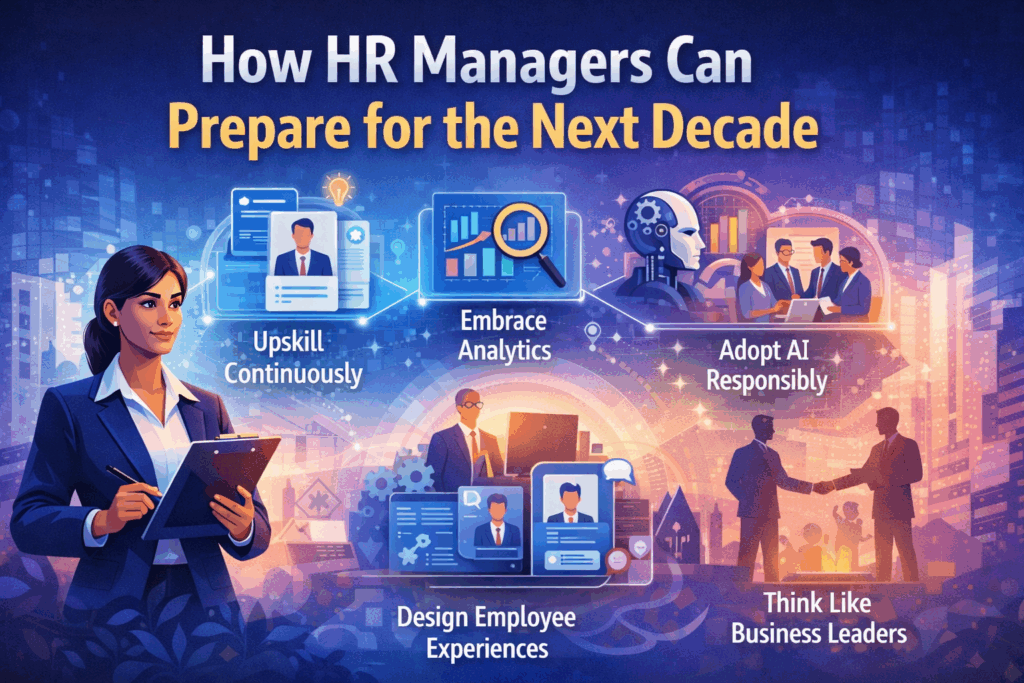
To prepare, HR leaders must:
- Upskill continuously
- Embrace analytics
- Invest in hiring quality
- Design employee experiences
- Adopt AI responsibly
- Think like business leaders
HR is no longer support.
HR is strategy.
Final Thoughts: The HR Role Is Being Redefined
The next decade will separate administrators from leaders.
HR managers who evolve will:
- Build stronger teams
- Influence business growth
- Create meaningful workplaces
Those who don’t will struggle to stay relevant.
The choice is clear.
Want to future-proof your hiring and HR strategy?
Start by fixing the most critical HR challenge — interview quality and hiring accuracy.
👉 Explore how AIInterview.in (ai recruiting tools) helps HR teams make smarter, bias-free, skill-based hiring decisions using AI-powered interviews and assessments.
Build teams that last. Not resumes that fail.