Table of Contents
- What does “payroll” mean in HR?
- Why payroll matters for HR and business
- Payroll process in HR — step by step
- Example: Sample payroll calculation (India)
- Payroll management in HR — systems, roles & best practices
- Payroll compliance in India — key laws & filings
- Common payroll mistakes (and how to avoid them)
- Payroll metrics HR should track
- Payroll automation & future trends
- Practical checklist — fix payroll in 30 days
- Case example: Indian SME payroll turnaround
- Conclusion
- FAQs
Payroll is one of those HR responsibilities that everyone notices only when something goes wrong. A late salary credit. A wrong deduction. A missing payslip. And suddenly, trust takes a hit.
If you’re an HR professional, founder, or payroll specialist in India, payroll isn’t just “salary processing.” It’s compliance, accuracy, employee experience, and risk management—all rolled into one monthly ritual.
This guide breaks payroll down clearly and practically. You’ll learn what payroll in HR really means, how the payroll process works step by step, and how to build strong payroll management in HR—without jargon or fluff.
What does “payroll” mean in HR?
Payroll in HR is the process of calculating, paying, and reporting employee salaries while ensuring statutory compliance and accurate records.
That’s the short version. Let’s unpack it properly.
Payroll meaning in HR
Payroll in HR refers to the end-to-end management of employee compensation—calculating earnings, deducting statutory and voluntary contributions, paying salaries, generating payslips, and filing compliance reports.
Actionable takeaway: If money moves from your company to employees, and the government needs a record of it, it’s part of payroll.
Why payroll matters for HR and business
Payroll sits at the intersection of people, money, and law. Getting it right protects both employees and the organisation.
Here’s why payroll is business-critical:
- Legal compliance: Errors can trigger penalties under EPF, ESIC, Income Tax, or Professional Tax laws
- Employee trust: Salary accuracy directly impacts morale and retention
- Cash-flow planning: Payroll is often the largest monthly expense
- Audit readiness: Clean payroll records simplify statutory and internal audits
- Brand reputation: Payroll errors travel fast—especially on Slack and WhatsApp
Actionable takeaway: Treat payroll as a risk-managed process, not a back-office task.
Payroll process in HR — step by step
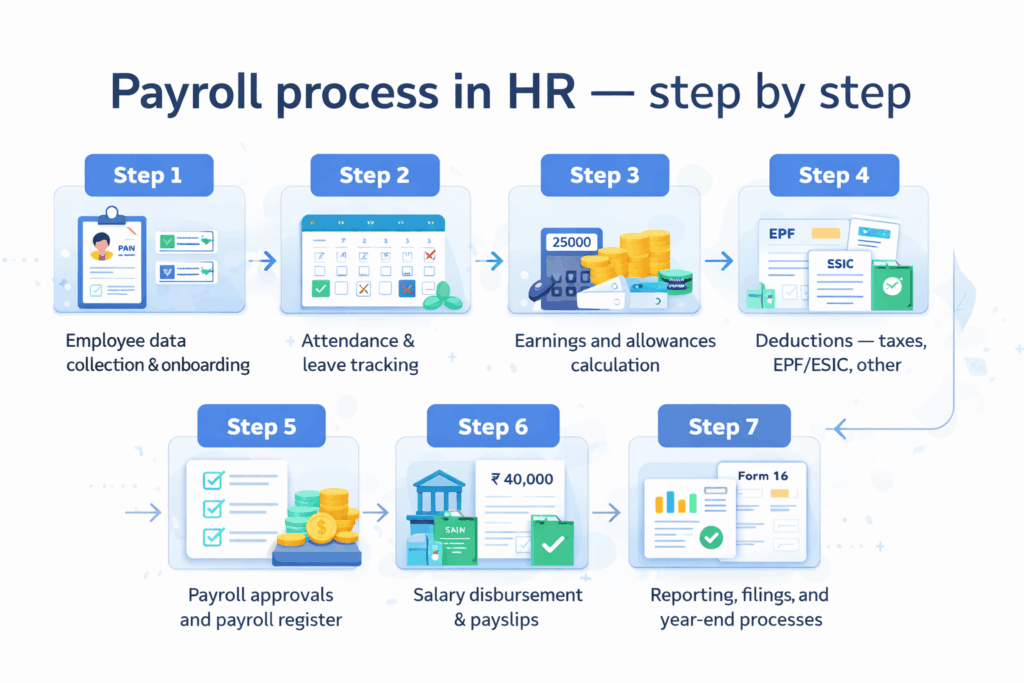
Below is the standard payroll process in HR, optimised for Indian organisations.
Step 1: Employee data collection & onboarding
Payroll starts when an employee joins.
You collect:
- PAN, Aadhaar (as required)
- Bank account details
- Salary structure (CTC breakup)
- EPF/ESIC eligibility details
- Tax declaration basics
Tip: Errors here flow downstream—double-check onboarding data.
Step 2: Attendance & leave tracking
Salary depends on days worked.
Inputs include:
- Attendance records
- Leave balances
- Loss of pay (LOP)
- Overtime or shift allowances (if applicable)
Many companies integrate biometric systems or HRMS tools here.
XGenPlus Mobile Attendance & Tracking System further simplifies this process with real-time, location-based attendance and automated leave tracking.
Step 3: Earnings and allowances calculation
HR calculates gross earnings, typically including:
- Basic salary
- HRA (House Rent Allowance)
- Special allowances
- Performance incentives (if monthly)
Step 4: Deductions — taxes, EPF/ESIC, others
This is where payroll compliance in India comes into play.
Common deductions:
- EPF (Provident Fund)
- ESIC (where applicable)
- Professional Tax
- Income Tax (TDS)
- Voluntary deductions (insurance, loans)
Step 5: Payroll approvals and payroll register
Before salaries are paid:
- Payroll summary is reviewed
- HR and finance approvals are taken
- Payroll register is finalised
This step prevents costly mistakes.
Step 6: Salary disbursement & payslips
Once approved:
- Salaries are credited via bank transfer
- Payslips are generated and shared
- Salary journals are posted in accounting systems
Step 7: Reporting, filings, and year-end processes
After payment:
- Statutory filings are completed
- Monthly and quarterly reports are prepared
- Year-end forms (Form 16) are generated
Actionable takeaway: Payroll doesn’t end on payday—compliance continues afterwards.
Example: Sample payroll calculation (India)
Here’s a simple payroll calculation example for one employee.
| Component | Amount (₹) | Formula / Notes |
| Basic Salary | 25,000 | Fixed |
| HRA | 12,500 | 50% of Basic |
| Special Allowance | 7,500 | Fixed |
| Gross Salary | 45,000 | Earnings total |
| EPF (Employee) | 3,000 | 12% of Basic |
| Professional Tax | 200 | State-specific |
| Income Tax (TDS) | 1,800 | As per slab |
| Total Deductions | 5,000 | — |
| Net Salary | 40,000 | Gross − Deductions |
Actionable takeaway: Transparent payslips reduce employee queries and disputes.
Payroll management in HR — systems, roles & best practices
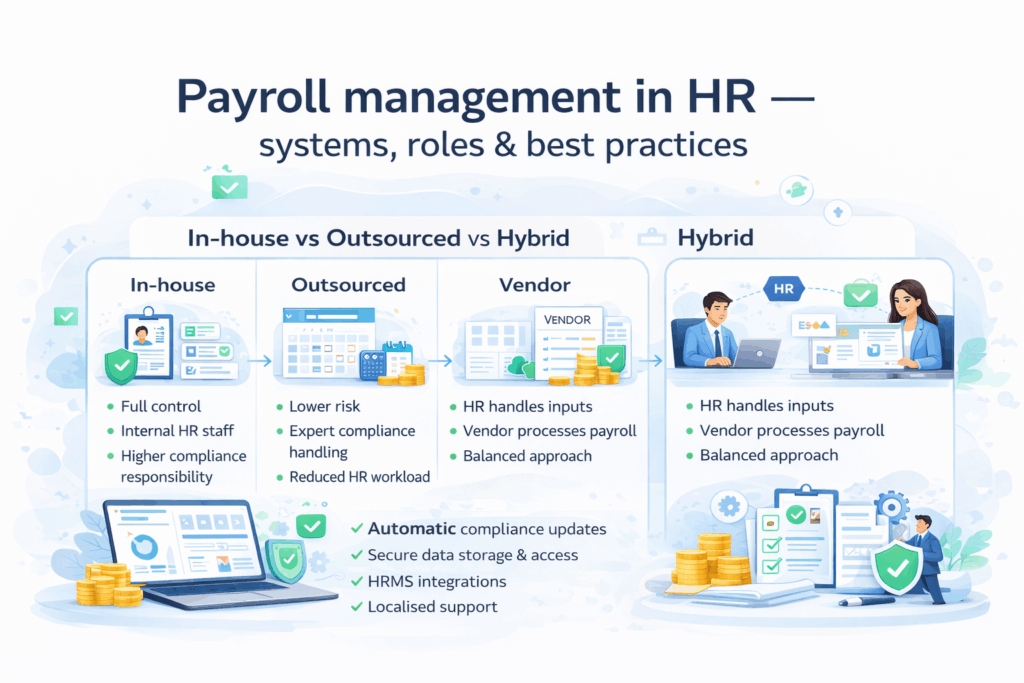
Payroll processing is transactional. Payroll management is strategic.
What is payroll management in HR?
Payroll management in HR is the structured planning, execution, control, and audit of payroll operations to ensure accuracy, compliance, and efficiency.
In-house vs outsourced vs hybrid payroll
In-house payroll
- Full control
- Requires trained staff
- Higher compliance responsibility
Payroll outsourcing
- Lower risk
- Expert compliance handling
- Less internal effort
Hybrid model
- HR manages inputs
- Vendor handles processing & compliance
Actionable takeaway: SMEs often benefit most from hybrid or outsourced payroll models.
Choosing payroll software — India checklist
When evaluating payroll software in India, look for:
- Automatic tax & compliance updates
- EPF, ESIC, PT, TDS support
- Secure data storage & access control
- HRMS and attendance integrations
- Employee self-service portals
- Responsive local support
Payroll workflows & internal controls
Strong payroll management includes:
- Segregation of duties (HR vs finance)
- Approval hierarchies
- Audit trails
- Version-controlled salary revisions
Actionable takeaway: Controls matter more as headcount grows.
Payroll compliance in India — key laws & filings
Payroll compliance is non-negotiable. At a high level, HR must manage:
- EPF: Monthly contributions & returns
- ESIC: Applicable for eligible employees
- Professional Tax: State-specific deductions & filings
- Income Tax (TDS): Monthly deposits, quarterly returns, Form 16
Note: Due dates and rules change. Always verify on official portals or consult a payroll expert.
Authoritative sources:
- EPFO portal (epfindia.gov.in)
- Income Tax India (incometax.gov.in)
Actionable takeaway: Compliance calendars should be part of payroll SOPs.
Common payroll mistakes (and how to avoid them)
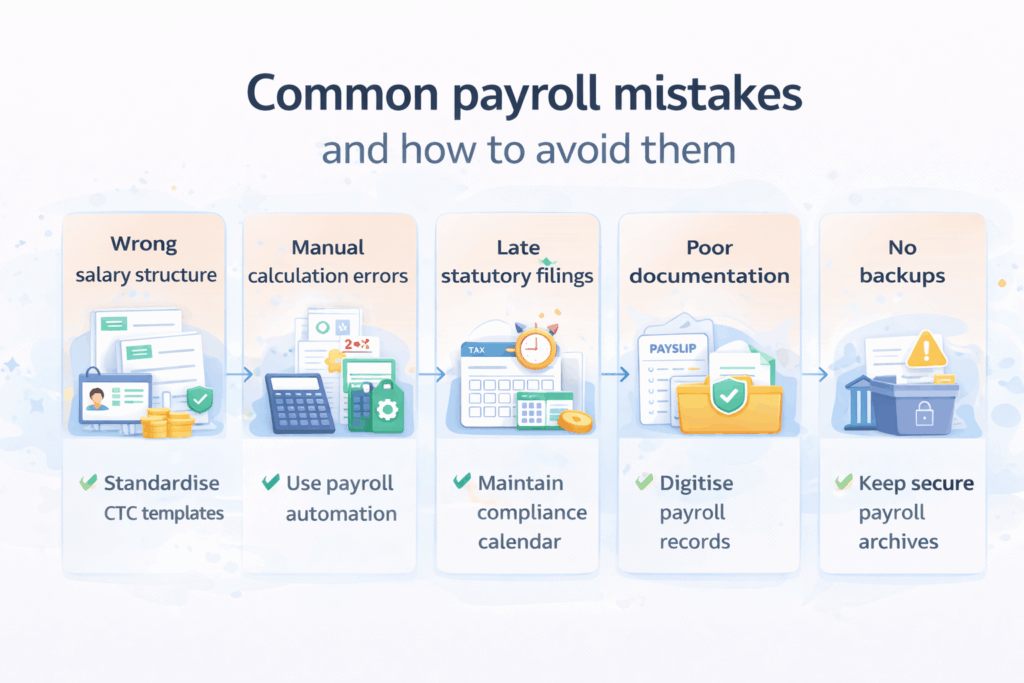
| Mistake | How to avoid |
| Wrong salary structure | Standardise CTC templates |
| Manual calculation errors | Use payroll automation |
| Late statutory filings | Maintain compliance calendar |
| Poor documentation | Digitise payroll records |
| No backups | Keep secure payroll archives |
Payroll metrics HR should track
Modern HR teams track payroll performance like any other process.
Key metrics:
- Payroll processing time
- Error rate per cycle
- Cost per payslip
- Compliance deviation incidents
- Employee payroll queries per month
Actionable takeaway: What you measure, you improve.
Payroll automation & future trends
Payroll is rapidly evolving.
Trends shaping payroll management:
- AI-driven error detection
- Automated compliance updates
- Integrated HRMS-payroll platforms
- Employee self-service payslips & tax declarations
- Cloud-based payroll systems
Actionable takeaway: Automation reduces risk and frees HR for strategic work.
Practical checklist — fix payroll in 30 days
Week 1
- Audit current payroll process
- Review salary structures & deductions
Week 2
3. Validate compliance status
4. Document payroll SOPs
Week 3
5. Evaluate payroll software or outsourcing
6. Train HR & finance stakeholders
Week 4
7. Run a parallel payroll test
8. Lock controls & approvals
Case example: Indian SME payroll turnaround
A 70-employee manufacturing SME in Pune handled payroll manually on spreadsheets. Errors were frequent, PF filings were delayed, and HR spent three full days each month fixing issues.
After switching to payroll automation with a compliance calendar:
- Payroll errors dropped to near zero
- Salary processing time reduced by 60%
- Employee payroll complaints fell sharply
Result: HR regained credibility—and time.
Conclusion
Payroll isn’t just an operational task—it’s a trust system. When payroll works smoothly, employees feel secure, HR gains credibility, and the business stays compliant.
Whether you’re scaling a startup or stabilising an enterprise HR function, mastering payroll process and payroll management in HR is a non-negotiable skill.
HR automation software becomes essential. By automating payroll calculations, statutory deductions, compliance tracking, and reporting, HR teams can reduce operational risk and reclaim valuable time for strategic work. Platforms like AIInterview help HR leaders move beyond manual processes by enabling smarter, data-driven HR operations that scale with the business.
FAQs
What is payroll in HR?
Payroll in HR is the process of calculating salaries, deducting taxes and statutory contributions, paying employees, and maintaining compliance records.
How does payroll differ from HR?
HR manages people strategy, while payroll focuses on salary processing and compliance. Payroll is often a specialised HR function.
What is payroll management in HR?
Payroll management in HR involves planning, controlling, auditing, and improving payroll systems to ensure accuracy and legal compliance.
How often should payroll be processed?
Most Indian organisations process payroll monthly, though some allowances or incentives may follow different cycles.
What documents are essential for payroll compliance in India?
PAN, salary registers, payslips, EPF/ESIC records, TDS challans, and statutory returns are essential.