Table of Contents
- What Are HR Metrics?
- HR Metrics vs HR Analytics
- Why HR Metrics Matter (Short, Practical Points)
- Types of HR Metrics (Explained Simply With Real-World Understanding)
- Sample HR Metrics Table (Easy to Read & Actionable)
- HR Metrics Dashboard: What It Should Show (With Sample Layout)
- How to Choose the Right HR Metrics (Actionable Guide)
- How to Present HR Metrics to Leadership (Simple Storytelling Tips)
- Common Pitfalls in HR Metrics (And Quick Fixes)
- Quick Templates & Formulas (Copy-Paste Ready)
- Tools & Tech for Tracking HR Metrics
- Wrap-Up & 3-Step Action Plan
- Conclusion
- FAQs (Quick, Schema-Friendly)
If you’ve ever been surprised by sudden resignations…
Or confused about why hiring feels slow even after adding more recruiters…
Then you already know why HR metrics matter.
Every HR leader in India faces these challenges. And most of them come down to one thing: not having the right numbers to guide decisions.
This guide explains HR metrics in simple English, with examples, formulas, dashboards — plus a free hiring checklist
What Are HR Metrics?
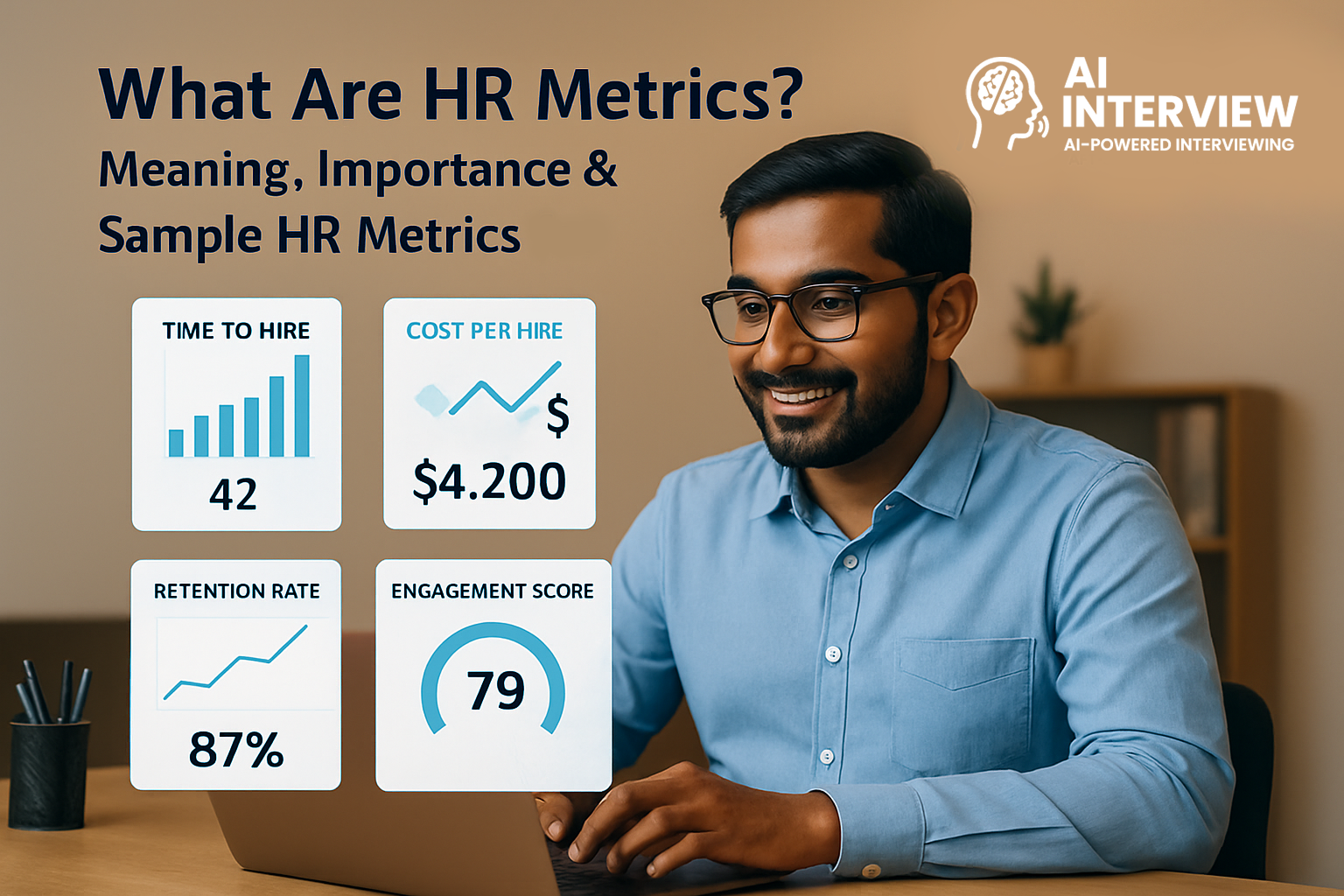
HR metrics are numbers that help you measure how well your people processes are working — from hiring and onboarding to engagement, performance and retention.
They give you clear answers to questions like:
- Are we hiring fast enough?
- Are we losing too many people?
- Is training actually helping employees?
- Which team needs attention?
Basic details:
- HR metrics = direct measurement.
- Helps HR teams make decisions based on data, not guesswork.
- Used by modern HR teams to improve hiring, retention, productivity and employee experience.
HR Metrics vs HR Analytics
People often mix these up. Here’s the simplest way to understand them:
- HR metrics = what’s happening (measurement)
- HR analytics = why it’s happening + what to do about it. (meaning + action)
Basic details:
- Metrics are raw numbers.
- Analytics adds meaning, insight and action.
- HR teams need both for better decisions.
Example:
- Metric: “Turnover Rate = 28%”
- Analytics: “Turnover is high because first-time managers aren’t trained well. Let’s run a training program and measure its impact.”
Why HR Metrics Matter (Short, Practical Points)
HR metrics matter because they keep you prepared. When you measure the right things, you avoid surprises and make better decisions.
Reasons HR metrics are important:
- Faster hiring: You quickly see what’s slowing recruitment.
- Lower hiring costs: You understand which channels bring best candidates.
- Better employee retention: You spot problem teams before people resign.
- Improved productivity: Performance data becomes clearer.
- Leadership trust: Numbers speak louder than opinions.
- Compliance and DEI tracking: Helps maintain transparency.
Basic details:
- HR metrics help companies avoid surprises.
- They improve communication with CEOs & managers.
- They make HR more strategic and respected.
Example:
At a Bangalore-based IT services firm, HR found that time-to-hire for Java roles was 48 days — far above industry reality. After reviewing sourcing-channel metrics, they shifted budget from job boards to referral bonuses. Time-to-hire dropped to 22 days. Metrics made the difference.
Types of HR Metrics (Explained Simply With Real-World Understanding)
HR metrics cover different stages of an employee’s journey — from how you hire them to how they perform, grow, stay, or eventually move on. When HR leaders clearly understand these categories, it becomes much easier to identify problems early and address them before they impact the business.
Below is a practical breakdown, explained in everyday language.
1) Recruitment Metrics
Recruitment metrics tell you exactly how well your hiring engine is running.
If hiring feels slow, expensive, or unpredictable, these numbers show you where the actual issue lies.
Examples
- Time to Hire: The number of days it takes to close a role from posting to offer acceptance.
- Cost per Hire: The total amount spent to make one hire — job ads, agency fees, recruiter time, tools, everything.
- Offer Acceptance Rate: Out of all the offers you roll out, how many candidates actually say yes.
Why it matters
- Gives a clear picture of hiring speed.
- Helps pinpoint delays — sometimes it’s interviews, sometimes it’s approvals, sometimes it’s sourcing.
- Shows which hiring channels really work for you.
- Improves the candidate experience because you can fix slow or confusing stages.
Basic insight
At its core, these metrics help you hire faster, spend smarter, and improve the quality of people coming into the company.
2) Performance & Productivity Metrics
These metrics reflect how well your people are actually contributing. Many companies assume performance issues are personal — but often, the data shows team-level patterns that leaders miss.
Examples
- Goal Completion Rate: How many goals or OKRs were actually achieved.
- Revenue per Employee: A simple way to see how efficiently the workforce is contributing to growth.
Why it matters
- Gives leaders a reality check on productivity levels.
- Highlights employees who need support, coaching, or recognition.
- Helps connect performance management to the company’s real business goals.
Basic insight
These metrics support better appraisals, smarter rewards, and more honest performance discussions.
3) Retention & Turnover Metrics
These metrics show how stable your workforce is.
If too many people leave — especially in a short time — it almost always points to deeper cultural or managerial issues.
Examples
- New-hire Retention Rate: Do new employees stay past the first few months?
- Voluntary Turnover Rate: How many employees leave by choice (resignations).
Why it matters
- High turnover hits productivity, hiring budgets, and team morale.
- Helps identify whether people are leaving due to managers, workload, compensation, or career growth issues.
- Shows which teams or roles need immediate HR attention.
Basic insight
Turnover is never “just turnover.” It usually reveals something bigger beneath the surface — and these metrics help you find it.
4) Compensation & Cost Metrics
These metrics help HR understand whether salaries are fair and competitive, and whether the HR team itself is adequately resourced.
Examples
- HR-to-Employee Ratio: How many employees each HR professional supports.
- Salary Competitiveness Index: Whether your salary ranges match market standards.
Why it matters
- Helps you create competitive salary structures.
- Supports better budgeting for increments, hiring, and benefits.
- Helps HR justify additional headcount or tools when workloads grow.
Basic insight
Compensation metrics ensure your company stays competitive and financially balanced.
5) Learning & Development (L&D) Metrics
Training only matters if it actually changes behaviour or improves performance.
That’s what these metrics help measure.
Examples
- Training Completion Rate: How many employees actually finish assigned training.
- Training Effectiveness Score: How much employees improve after training (through assessments or surveys).
Why it matters
- Shows whether training programs work or need improvement.
- Helps identify which teams need additional skill development.
- Supports leadership pipelines and succession planning.
Basic insight
L&D metrics ensure training is practical and adds real value — not just a checkbox exercise.
6) Diversity & Inclusion (D&I) Metrics
These metrics help you understand representation and fairness across teams, roles, and leadership levels.
Examples
- Diversity Ratio: How diverse your workforce is across gender, background, or other demographic groups.
- Women in Leadership: The percentage of managerial or leadership roles held by women.
Why it matters
- Creates fairer workplaces and supports inclusive decision-making.
- Strengthens employer branding — candidates expect diversity today.
- Helps reduce bias in hiring and promotions.
Basic insight
D&I metrics guide companies toward building balanced and inclusive teams where everyone has a fair chance to grow.
7) Engagement & Wellbeing Metrics
These metrics reveal how your employees truly feel — their motivation, satisfaction, stress levels, and overall connection to the workplace.
Examples
- Employee Engagement Score: Comes from surveys measuring how involved employees feel.
- Absenteeism Rate: How often employees take unplanned leave.
- eNPS (Employee Net Promoter Score): Whether employees would recommend your workplace to others.
Why it matters
- Engagement impacts productivity, quality of work, and customer experience.
- Helps HR catch early signs of burnout or demotivation.
- Strong engagement consistently leads to better retention and performance.
Basic insight
Healthy engagement builds a healthier company — because motivated employees stay longer, perform better, and contribute to a stronger culture.
Sample HR Metrics Table (Easy to Read & Actionable)
Below is a simple table HR leaders can use immediately.
| Metric | What It Means | Why It’s Important | Good to Aim For (India) |
| Time to Hire | How many days you take to hire someone | Faster hiring = less work delay | 20–45 days |
| Cost per Hire | How much money you spend to hire one person | Helps manage HR budget | ₹15k–₹60k+ |
| Offer Acceptance Rate | How many people say “yes” to your job offer | Shows how attractive your company is | 70–90% |
| Quality of Hire | How well new employees perform in their first year | Tells if you hired the right people | No fixed target |
| New-Hire Retention | How many new employees stay for at least 3–6 months | Shows onboarding quality and culture | 75–90% |
| Turnover Rate | How many employees leave the company | Helps track stability and satisfaction | 10–25% |
| Absenteeism Rate | How often employees are absent | Shows engagement and well-being | Below 5% |
| Engagement Score | How happy and motivated employees feel | Higher engagement = better productivity | 60–80% |
| HR-to-Employee Ratio | How many employees each HR person manages | Ensures HR is not overloaded | 1:60 to 1:100 |
| Training Effectiveness | Whether employees actually learn from training | Shows ROI of training programs | 20–40% improvement |
| Diversity Ratio | Mix of people from different backgrounds | Supports fairness & inclusion | Varies by company |
| Average Tenure | How long employees stay on average | Shows loyalty and work culture | 2.5–5 years |
HR Metrics Dashboard: What It Should Show (With Sample Layout)
A good HR metrics dashboard should give you clarity in a glance.
Whether you use Google Sheets, Power BI, or a full HR analytics tool, the widgets should tell you:
Recommended Widgets
- Open roles + Time-to-hire trend
- Cost per hire (month-wise)
- Turnover heatmap by department
- Engagement score & absenteeism
- Diversity snapshot
- New-hire retention (90-day view)
Real-time vs Monthly
- Recruitment metrics: real-time or weekly
- Engagement & turnover: monthly
- DEI & L&D metrics: quarterly
Quick UX Tips
- Use traffic-light colors for clarity.
- Add filters: department, location, and role type.
- Let leaders export CSV/PDF easily.
How to Choose the Right HR Metrics (Actionable Guide)
Not every metric matters to every company.
Here’s how to pick the right ones:
Checklist
- Does this metric support a business goal?
- Is it easy to collect without manual pain?
- Can it be tracked consistently?
- Can managers actually act on it?
- Does it have a clear owner?
Prioritization Framework
- Must-track: Time-to-hire, turnover, engagement, cost per hire
- Should-track: training effectiveness, new-hire retention
- Nice-to-have: DEI metrics, revenue per employee
How to Present HR Metrics to Leadership (Simple Storytelling Tips)
Leaders don’t want 40 charts. They want one insight that triggers action.
Use this simple structure:
- Headline insight: “Turnover in Sales increased from 12% to 22% last quarter.”
- Why it happened: “Exit interviews show pay mismatch + workload issues.”
- What to do: “Revise incentive structure + hire 3 more SDRs.”
Cadence
- Weekly: recruitment KPIs
- Monthly: leadership dashboards
- Quarterly: strategic metrics (DEI, L&D)
Small workplace story:
During a hiring freeze at a Mumbai startup where I had previously consulted, we reduced the time-to-hire by 30% simply by showing the founder that most delays stemmed from interview scheduling, not sourcing. Once he saw the metric, he fixed it in one day.
Common Pitfalls in HR Metrics (And Quick Fixes)
- Vanity metrics:
Fix: Track only metrics that change decisions. - Inconsistent definitions:
Fix: Use standard formulas across the company. - Incomplete data from teams:
Fix: Automate collection via ATS or scripts. - Overloaded dashboards:
Fix: Limit to 8–12 key widgets. - Metrics without owners:
Fix: Assign owners for every metric.
Quick Templates & Formulas (Copy-Paste Ready)
Here are simple formulas any HR team can use in Excel/Sheets.
- Time to Hire
=DATEDIF(Job_Posted_Date, Offer_Accepted_Date, “D”) - Cost per Hire
=Total_Hiring_Cost / Number_of_Hires - Turnover Rate
=(Employees_Left / Average_Employees) * 100 - Offer Acceptance Rate
=(Accepted_Offers / Total_Offers) * 100 - Absenteeism Rate
=(Absent_Days / Total_Work_Days) * 100 - New-hire Retention (90 days)
=(New_Hires_Still_Employed / Total_New_Hires) * 100 - Training Effectiveness
=(Post_Score – Pre_Score) / Pre_Score * 100 - Engagement Score
=AVERAGE(Survey_Responses)
Tools & Tech for Tracking HR Metrics
You don’t need expensive tools to start.
For Small Indian Companies / Startups
- Google Sheets + a basic ATS (founders love this)
- Automate with simple scripts or Zapier integrations
For Mid-market
- HRIS + BI tools like Power BI, Zoho People Analytics
For Enterprise
- People analytics tools (Darwinbox, Visier, SAP SuccessFactors)
Low-cost approach (most practical in India):
ATS + Google Sheets dashboard → reliable, cheap, scalable.
Wrap-Up & 3-Step Action Plan
If you want HR to be truly strategic, metrics are non-negotiable.
Here’s a 3-step plan you can apply this month:
1. Discover
Pick 6–10 HR metrics aligned to business goals.
2. Dashboard
Build a simple real-time dashboard (Google Sheets is enough to start).
3. Act
Review monthly, share insights with leaders, and adjust hiring/engagement strategies.
Conclusion
HR metrics aren’t just numbers on a dashboard — they’re the simplest way to understand what’s really happening inside your organisation. Whether you’re trying to hire faster, reduce attrition, improve performance, or strengthen culture, the right metrics give you clarity and control.
When HR teams track these indicators consistently, decision-making stops being reactive. You can spot problems early, fix bottlenecks before they grow, and help your leaders see exactly where the business needs support. Over time, even small improvements in hiring speed, engagement, retention, or training effectiveness create a compound impact across the company.
If you’re just getting started, begin with a handful of essential metrics and build from there. Keep things simple, update your dashboard regularly, and use every metric as a conversation starter with managers and leadership. The more you rely on data, the more strategic, confident, and future-ready your HR function becomes.
FAQs (Quick, Schema-Friendly)
1. What are HR metrics?
HR metrics are numbers that measure the health of hiring, performance, retention, engagement, and people costs in a company.
2. What is the difference between HR metrics and HR analytics?
Metrics measure what is happening; analytics explains why it’s happening and what action to take.
3. Which HR metrics are most important?
Time-to-hire, cost-per-hire, turnover rate, engagement score, and new-hire retention rate are essential for most companies.
4. How do I start tracking HR metrics?
Begin with simple formulas, collect clean data, create a basic dashboard, and review it monthly.
5. What tools help track HR metrics?
Google Sheets, ATS platforms, BI tools, and people analytics tools, depending on company size.