Table of Contents
- What Is an AI Interview Tool?
- Why Traditional Interviews Are Breaking Down
- How AI Interview Software Works
- Key Benefits of Using an AI Interview Tool
- Traditional vs AI vs Hybrid Interviews: A Quick Comparison
- Real-World Example: High-Volume Hiring in India
- Pros and Cons of AI Interview Software
- Common Objections
- Ethical Concerns: Bias, Privacy, and Fairness
- Cost and ROI Considerations
- How to Implement an AI Interview Tool: Step-by-Step
- 30-Day Action Checklist for Recruiters
- The Future of Hiring Is Assisted, Not Automated
- Frequently Asked Questions (FAQs)
Hiring today feels harder than it should.
Recruiters are overwhelmed with CVs, candidates are tired of lengthy processes, and great talent still slips through the cracks. This is exactly where an AI interview tool is changing the game.
Across India’s fast-moving hiring landscape—from startups scaling in months to enterprises hiring at volume—AI interview software is redefining how interviews are conducted, evaluated, and scaled.
This guide explains what AI interviews are, how they work, where they help (and where they don’t), and how HR teams can implement them responsibly—without hype, fluff, or unrealistic promises.
What Is an AI Interview Tool?
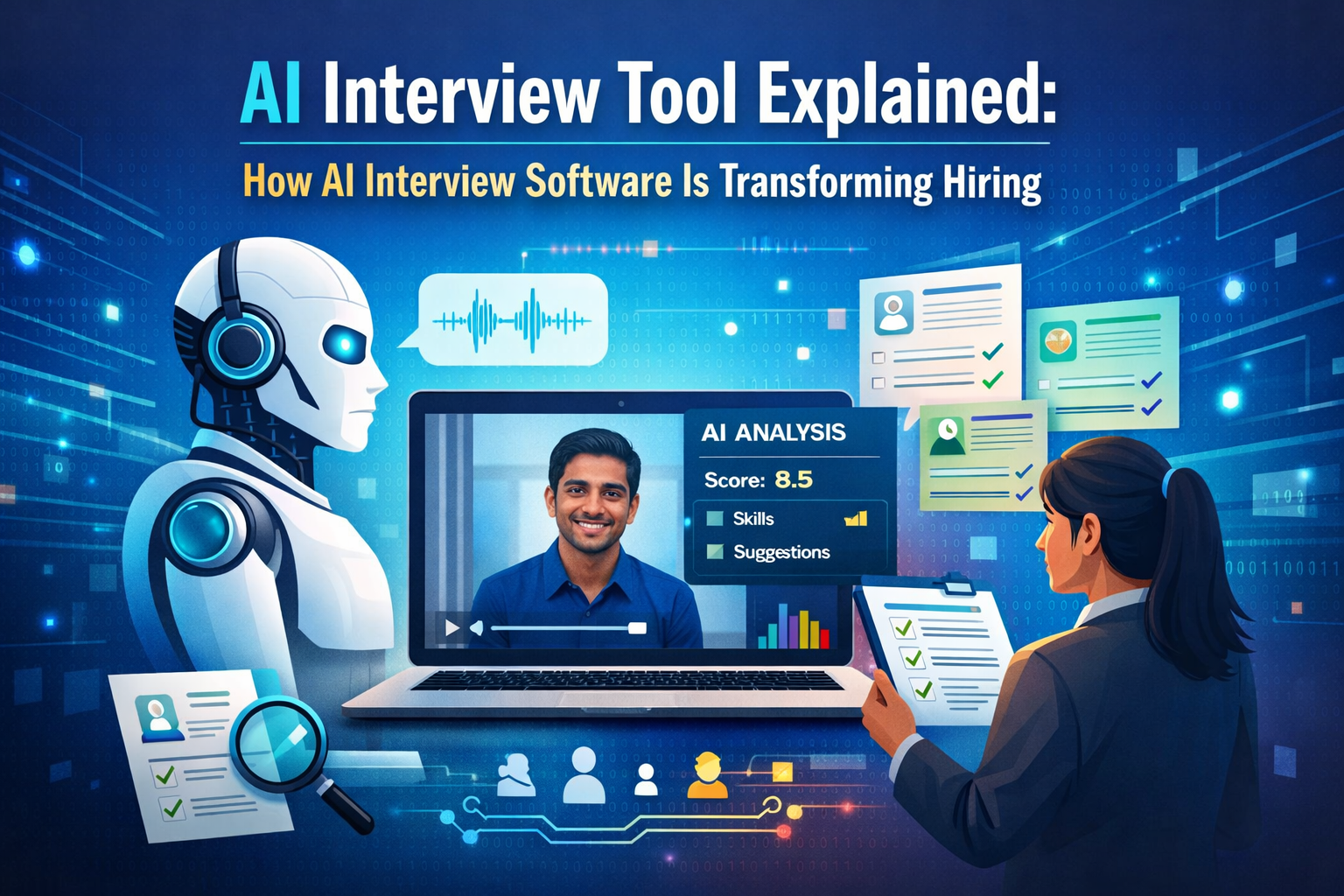
An AI interview tool is software that uses artificial intelligence to automate and enhance parts of the interview process. Instead of relying only on live human interviewers, the system evaluates candidates through structured audio or text-based interviews using predefined criteria.
In simple terms, it acts as an interviewer AI—asking questions, recording responses, analyzing them, and presenting insights to recruiters.
This doesn’t mean replacing humans. It means reducing repetitive work, increasing consistency, and improving decision quality in early and mid-stage hiring.
Why Traditional Interviews Are Breaking Down
Let’s be honest. The traditional interview model struggles at scale.
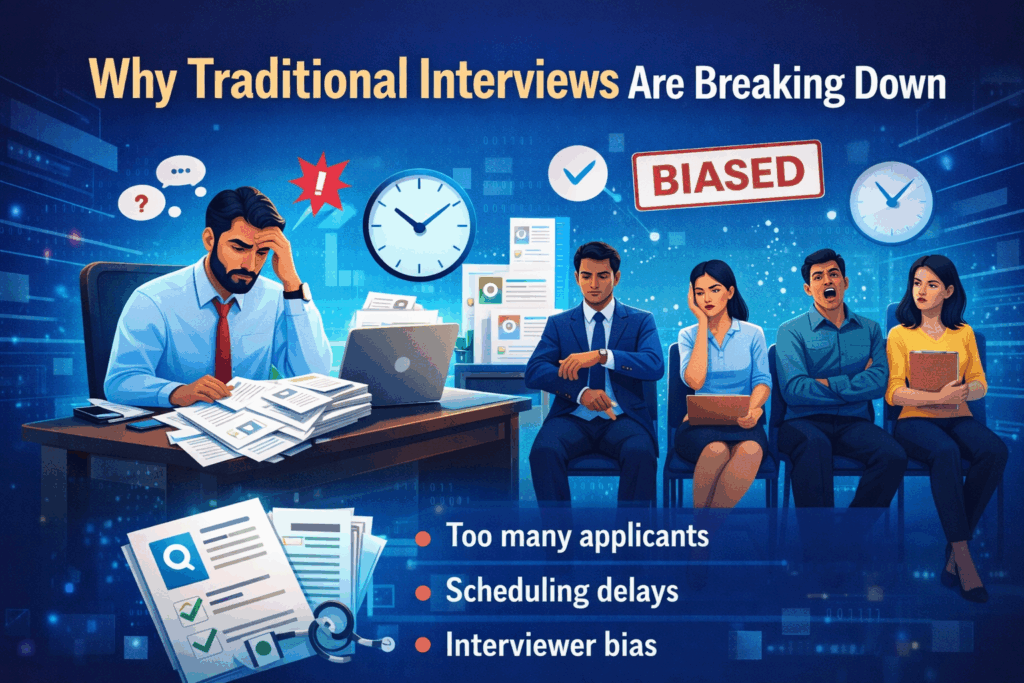
Common challenges recruiters face:
- Too many applications, too little time
- Interviewer bias and inconsistency
- Scheduling delays (especially for remote roles)
- Long time-to-hire is causing candidate drop-offs
- Manual screening that adds little value
In India alone, recruiters often handle hundreds of applicants per role, especially for sales, customer support, tech support, and graduate hiring. Human-only interviews simply don’t scale well.
That’s why AI tools for interview automation are gaining rapid adoption.
How AI Interview Software Works
Most AI based interview platforms follow a structured flow:
1. Interview Design
Recruiters configure:
- Role-specific questions
- Competency areas (communication, problem-solving, role skills)
- Interview format (audio interview, text)
2. Candidate Interview
Candidates complete the interview asynchronously:
- Record audio responses
- Answer scenario-based or behavioural questions
- Complete the interview at their convenience
This flexibility alone significantly improves candidate experience.
3. AI Analysis
The interviewer AI analyses responses using:
- Speech clarity and structure
- Relevance of answers
- Keyword and competency mapping
- Response consistency (not personality judgment)
4. Recruiter Insights
HR teams receive:
- Structured scores
- Side-by-side candidate comparisons
- Shortlisted recommendations
- Interview recordings for human review
AI assists decision-making—it does not make final hiring decisions.
Key Benefits of Using an AI Interview Tool
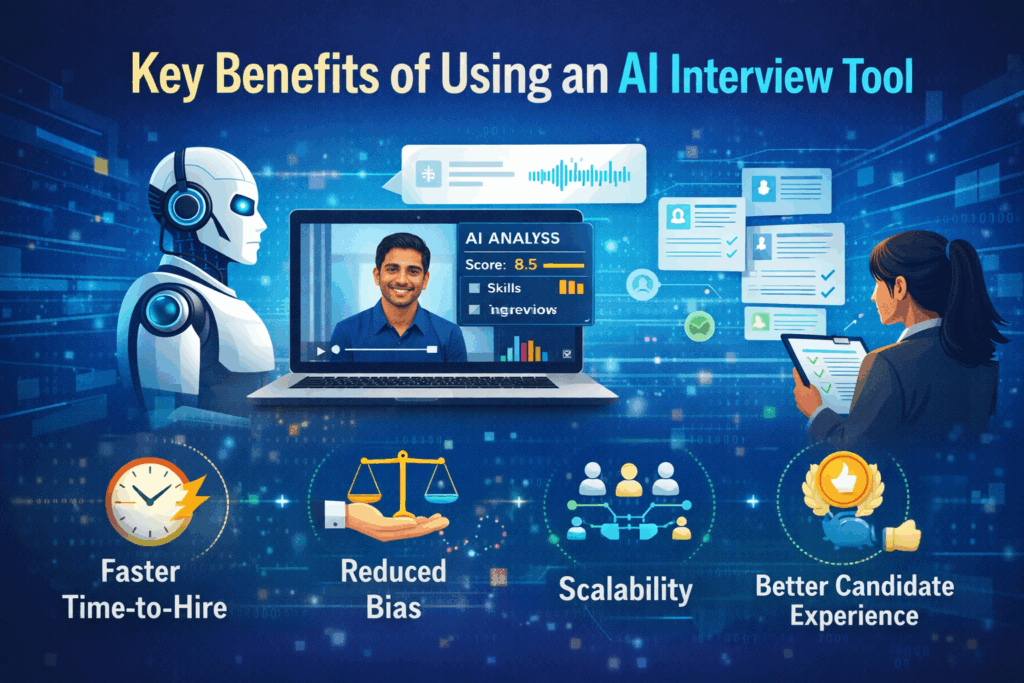
1. Faster Time-to-Hire
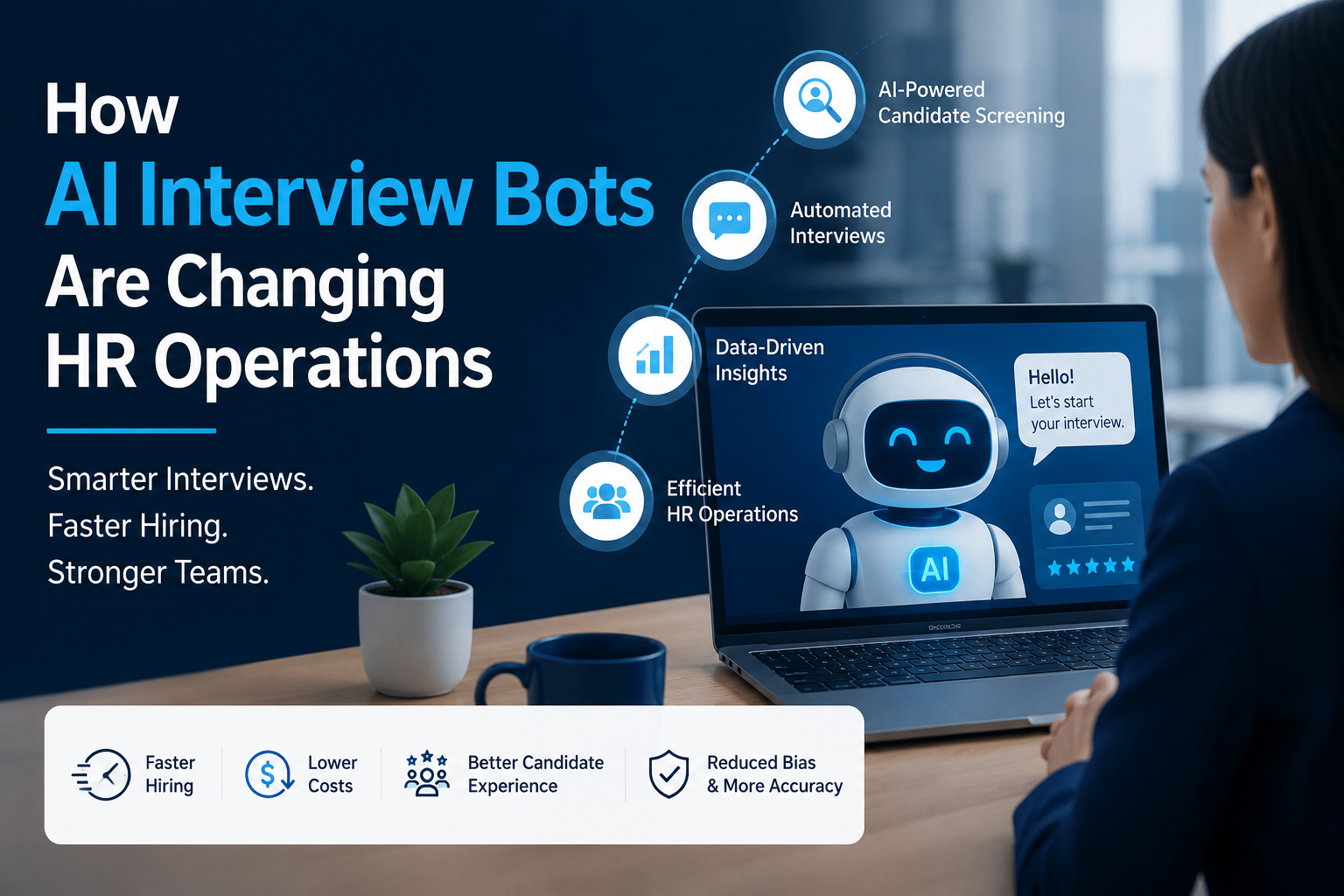
AI interviews can cut screening time by 60–70% by eliminating manual first-round interviews.
2. Reduced Bias (When Used Correctly)
Structured, criteria-based evaluation reduces:
- Mood-based decisions
- Halo effect
- Inconsistent questioning
3. Scalability
Whether hiring 10 or 10,000 candidates, AI interview software scales without burnout.
4. Better Candidate Experience
Candidates:
- Interview at a convenient time
- Avoid repeated screening calls
- Feel evaluated fairly
This is especially important in India’s competitive job market.
5. Cost Efficiency
Lower interviewer hours + faster hiring = strong ROI over time.
Traditional vs AI vs Hybrid Interviews: A Quick Comparison
| Metric | Traditional Interviews | AI Interview Software | Hybrid Approach |
| Time-to-hire | Slow | Fast | Medium |
| Bias risk | High | Low–Medium | Low |
| Scalability | Poor | Excellent | Good |
| Candidate experience | Inconsistent | High | High |
| Cost per hire | High | Low | Medium |
Best practice: Most organisations succeed with a hybrid approach—AI for screening, humans for final rounds.
Real-World Example: High-Volume Hiring in India
Consider a mid-sized Indian BPO hiring 300 customer support executives in 45 days.
Before AI interviews:
- 6 recruiters
- 2 interview rounds
- 3–4 weeks just for screening
- High drop-off rates
After adopting an AI interview tool:
- Automated first-round interviews
- Candidates completed interviews within 48 hours
- Recruiters reviewed top 30% only
- Hiring completed 12 days faster
Result: Lower cost, faster hiring, better candidate satisfaction.
Pros and Cons of AI Interview Software
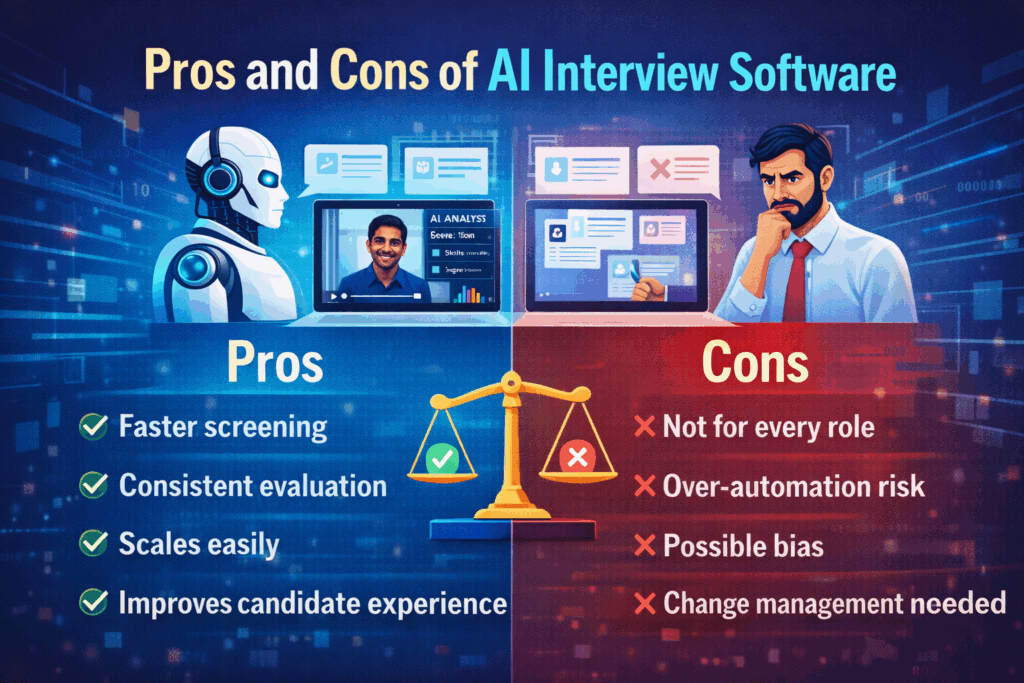
Like any hiring technology, AI interview software works best when you understand both its strengths and its limitations. Used correctly, it can transform screening. Used blindly, it can create new problems. Let’s break it down clearly.
Pros of AI Interview Software
1. Faster Screening and Shorter Time-to-Hire
An AI interview tool can screen hundreds of candidates in the time it takes a recruiter to conduct a few phone calls. First-round interviews happen automatically, often within hours of application.
For high-volume roles, this alone can reduce hiring cycles by 50–70%.
2. Consistent and Structured Evaluation
Unlike human interviews that vary by mood, experience, or bias, an interviewer AI:
- Asks the same questions
- Evaluates against the same criteria
- Applies uniform scoring
This consistency is especially valuable in early-stage screening.
3. Improved Candidate Experience
Many candidates prefer asynchronous AI interviews because they:
- Choose their own time
- Avoid repeated screening calls
- Experience less pressure than live interviews
This flexibility improves overall candidate experience, particularly for working professionals and fresh graduates in India.
4. Scales Without Adding Recruiter Workload
Whether you receive 50 applications or 5,000, AI tools for interview automation scale effortlessly. Recruiters spend time reviewing insights—not scheduling calls.
This is critical for campus hiring, BPOs, sales teams, and seasonal recruitment.
5. Cost Efficiency Over Time
While AI interview software has an upfront cost, it significantly reduces:
- Recruiter hours
- Interview scheduling effort
- Drop-off rates
For organisations hiring regularly, ROI typically becomes visible within 3–6 months.
Cons of AI Interview Software
- Needs careful configuration
- Not suitable for all roles
- Risk of over-reliance on automation
- Requires ethical oversight
AI is powerful—but only when used thoughtfully.
Common Objections
“Will AI replace recruiters?”
No. AI handles repetitive screening so recruiters can focus on human judgment and relationship-building.
“Is AI interview software biased?”
AI reflects how it’s designed. Bias reduces when:
- Clear criteria are used
- Training data is monitored
- Human review is included
“Do candidates trust AI interviews?”
Yes—when the process is transparent and respectful. According to Harvard Business Review, candidates value clarity and fairness more than the interviewer format.
Ethical Concerns: Bias, Privacy, and Fairness
Responsible use of AI interviews requires:
Bias Mitigation
- Avoid emotion or personality scoring
- Focus on job-related competencies
Data Privacy
- Secure storage of interview recordings
- Compliance with Indian IT and data protection norms
Transparency
- Inform candidates clearly about AI usage
- Allow human review and appeal
Ethics isn’t optional—it’s foundational.
Cost and ROI Considerations
AI interview tools are usually priced:
- Per interview
- Per role
- Subscription-based
ROI comes from:
- Reduced recruiter hours
- Faster hiring cycles
- Lower drop-offs
- Better quality shortlists
Most organizations see ROI within 3–6 months for volume roles.
How to Implement an AI Interview Tool: Step-by-Step
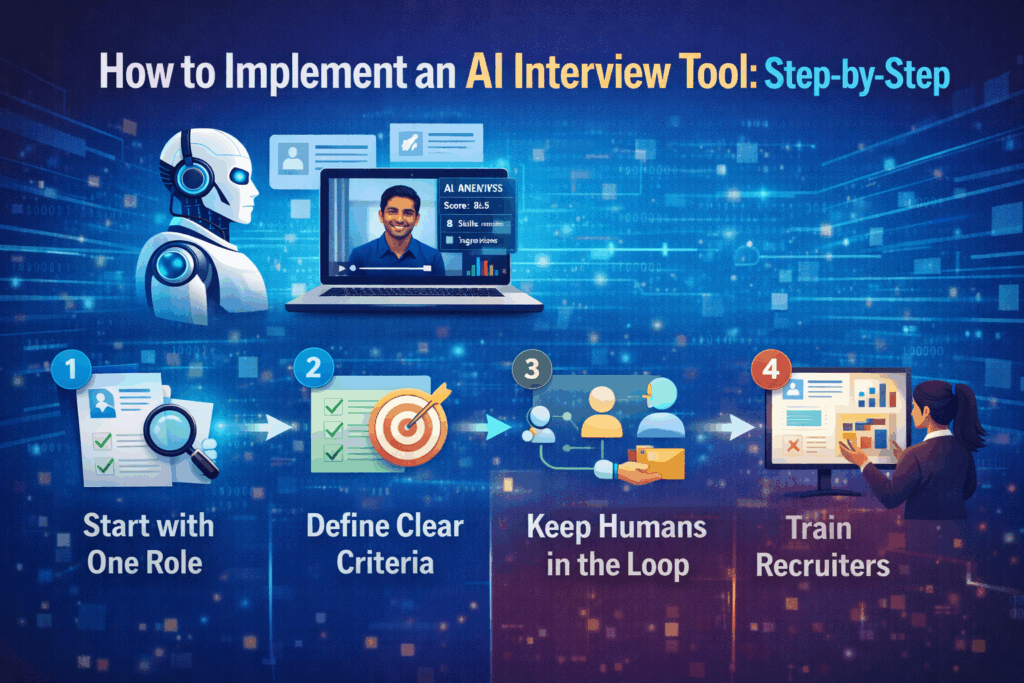
Step 1: Start with One Role
Choose a role with:
- High volume
- Standardised requirements
Step 2: Define Clear Evaluation Criteria
Focus on:
- Communication
- Role-specific knowledge
- Problem-solving
Step 3: Keep Humans in the Loop
AI screens. Humans decide.
Step 4: Train Recruiters
AI tools are only effective when recruiters understand the insights.
30-Day Action Checklist for Recruiters
- Identify roles suitable for AI screening
- Pilot AI interviews with 1–2 openings
- Review candidate feedback weekly
- Set bias and privacy guidelines
- Track time-to-hire and drop-off metrics
The Future of Hiring Is Assisted, Not Automated
AI interviews are not about removing humans from hiring. They’re about making hiring fairer, faster, and more scalable.
Used responsibly, an AI interview tool becomes a strategic advantage—not a risk.
Explore how AIInterview.in helps recruiters hire faster, fairer, and smarter with AI-powered interviews.
Frequently Asked Questions (FAQs)
What is an AI interview tool?
An AI interview tool automates interview screening using structured questions and AI-assisted analysis.
Are AI interviews legal in India?
Yes, when data privacy, transparency, and fairness guidelines are followed.
Do candidates prefer AI interviews?
Many candidates prefer asynchronous AI interviews for flexibility and reduced pressure.
Can AI interviews replace face-to-face interviews?
No. They work best for early-stage screening, not final decisions.
Which roles benefit most from AI interview software?
High-volume roles like sales, support, graduate hiring, and tech screening.