
Table of Contents
- Introduction — Why Every HR Team Is Talking About AI in HR Right Now
- Why AI in HR Matters Now
- Practical Use Cases of AI in HR Department
- Benefits of AI in HR — At a Glance
- Risks, Ethical Concerns & How to Mitigate Them
- How to Implement AI in Your HR Department
- Measuring ROI & KPIs for AI in HR
- AI in HR Course — Why HR Professionals Must Upskill
- Best Practices Before Buying an AI HR Tool
- Conclusion
- FAQ’s
Introduction — Why Every HR Team Is Talking About AI in HR Right Now
It’s Friday evening. Your ATS has 1,200+ resumes waiting. Hiring managers want shortlists by Monday. Candidates keep following up. And your HR team is already stretched thin.
This is where AI in HR stops being a buzzword and begins to become a necessity.
Across India and globally, HR departments are under pressure to hire faster, engage more effectively, reduce bias, and achieve more with leaner teams. Artificial intelligence is stepping in, not to replace HR but to amplify human decision-making.
In this article, we break down the practical use cases of AI in the HR Department, real examples from companies using it today, measurable benefits, risks to watch out for, and how HR professionals can upskill with an AI in HR course to stay relevant in the AI-first workplace.
Why AI in HR Matters Now
Three forces are reshaping HR faster than ever:
- Talent shortages and skill gaps across tech, BFSI, healthcare, and manufacturing
- Post-pandemic workforce shifts — hybrid work, gig talent, higher attrition
- Data overload — resumes, engagement surveys, performance metrics, learning data
Traditional HR systems simply can’t keep up.
According to industry studies, HR professionals spend 60–70% of their time on repetitive administrative work, leaving little room for strategic people initiatives.
That’s why artificial intelligence in HR is no longer optional—it’s strategic infrastructure.
Quick Snapshot — AI-Powered HR vs Traditional HR
Traditional HR
- Manual resume screening
- Static job descriptions
- Reactive attrition handling
- Annual performance reviews
- Limited insights from data
AI-Enabled HR
- Automated resume parsing and ranking
- Skills-based hiring
- Predictive attrition alerts
- Continuous performance insights
- Data-driven decision-making
Practical Use Cases of AI in HR Department
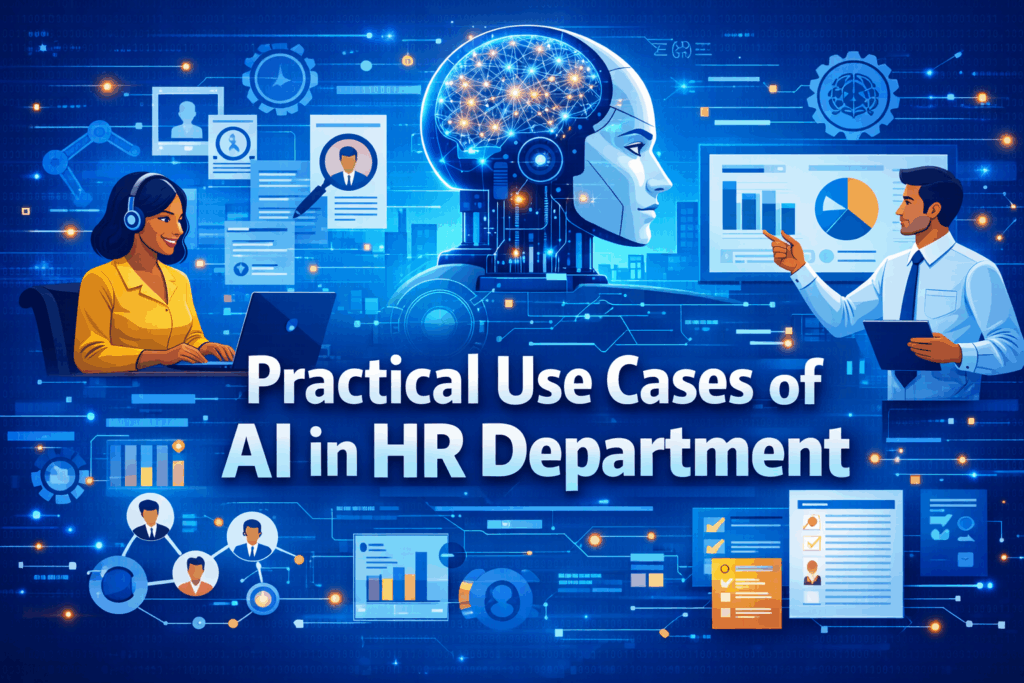
Let’s move from theory to reality.
Talent Sourcing & Resume Screening
What AI does
AI tools scan resumes, extract skills, rank candidates, and match profiles to job requirements within seconds.
Key benefits
- 70–80% reduction in resume screening time
- Skills-based shortlisting over keyword matching
- Improved quality of hire
Real example
A large Indian IT services firm used AI-driven resume screening to shortlist candidates for campus hiring. Shortlisting time dropped from 5 days to under 6 hours, while interview-to-offer ratios improved by 30%.
Expected impact
- Faster time-to-hire
- Reduced recruiter burnout
- More consistent shortlisting
Candidate Assessment & Interview Automation
What AI does
- Automates interview scheduling
- Conducts Audio and video interviews
- Analyses speech patterns, responses, and competencies
Key benefits
- 24×7 interview availability
- Structured, standardised evaluations
- Reduced interviewer bias
Example
Companies using AI interview platforms report 50–60% faster hiring cycles and improved candidate experience scores.
AIInterview, for instance, enables HR teams to assess candidates at scale while keeping human decision-makers in control.
Onboarding & Employee Experience
What AI does
- Chatbots answer employee queries
- Automated document collection
- Personalised onboarding journeys
Benefits
- Faster employee productivity
- Fewer HR tickets
- Better Day-1 experience
Example
An Indian fintech firm deployed an AI HR chatbot for onboarding FAQs. HR query volume reduced by 40%, and new-hire satisfaction scores rose sharply.
Learning & Development (L&D) and Internal Mobility
What AI does
- Maps employee skills
- Recommends learning paths
- Identifies internal mobility opportunities
Benefits
- Personalised learning at scale
- Better retention
- Future-ready workforce
Example
An enterprise used AI-based skill mapping to identify internal candidates for open roles, reducing external hiring costs by 25%.
Performance Management & People Analytics
What AI does
- Analyses performance trends
- Predicts attrition risk
- Tracks engagement sentiment
Benefits
- Early intervention before burnout
- Data-driven performance reviews
- Objective insights
Example
AI-driven people analytics helped a mid-size organisation reduce voluntary attrition by 18% in one year.
Payroll, Compliance & HR Operations Automation
What AI does
- Automates payroll checks
- Flags compliance risks
- Reduces manual errors
Benefits
- Fewer payroll mistakes
- Improved compliance
- Lower operational cost
Benefits of AI in HR — At a Glance
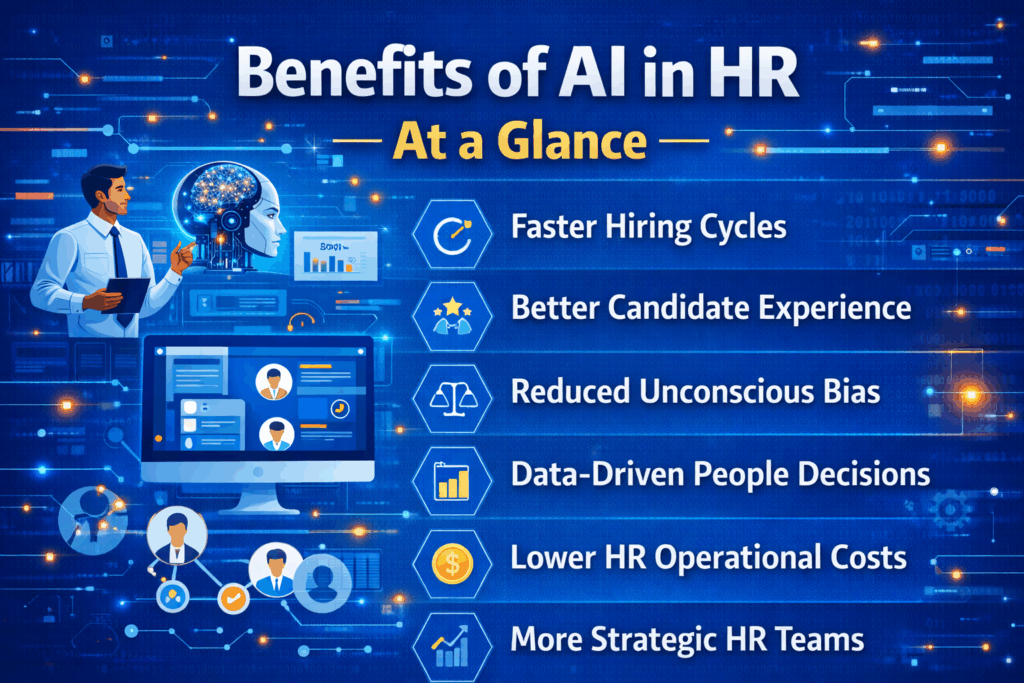
- Faster hiring cycles
- Better candidate experience
- Reduced unconscious bias
- Data-driven people decisions
- Lower operational costs
- Strategic HR transformation
Risks, Ethical Concerns & How to Mitigate Them
AI is powerful—but not perfect.
Key risks
- Algorithmic bias
- Data privacy issues
- Lack of transparency
- Employee mistrust
Practical Mitigation Checklist
- Keep human-in-the-loop for decisions
- Audit AI models regularly
- Use explainable AI tools
- Ensure data privacy compliance
- Communicate clearly with employees
How to Implement AI in Your HR Department
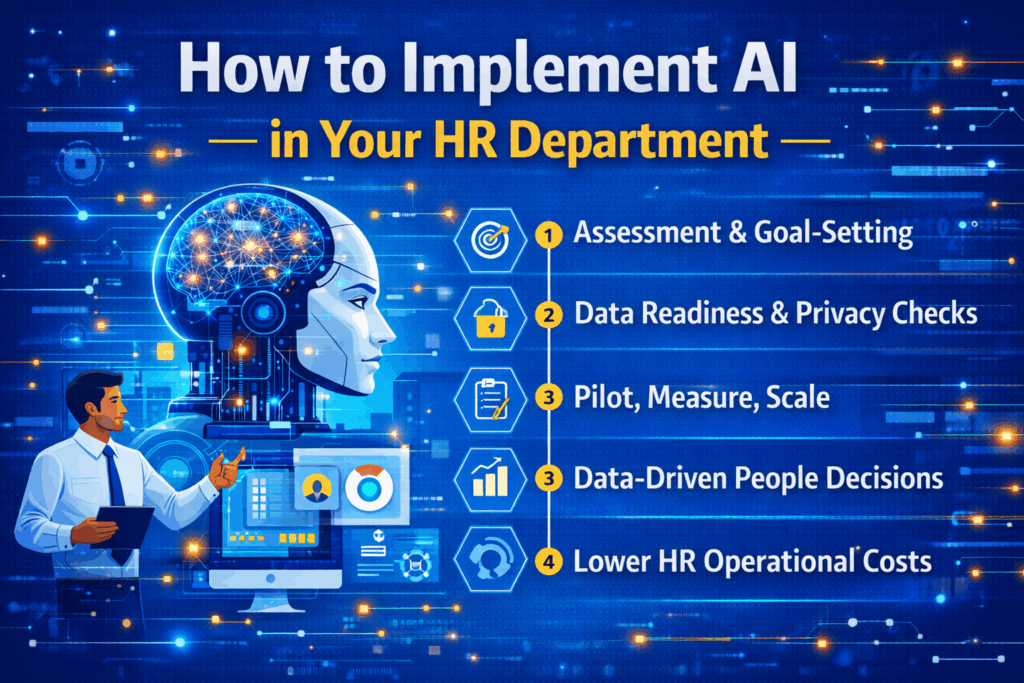
Step 1 — Assess & Set Clear Goals
Start with pain points: hiring speed, attrition, engagement.
Step 2 — Data Readiness & Privacy
Clean data. Secure consent. Follow Indian data laws.
Step 3 — Pilot, Measure, Scale
Start small. Measure ROI. Expand gradually.
Step 4 — Change Management & Upskilling
HR teams must learn how AI works. This is where an AI in HR course becomes essential.
Measuring ROI & KPIs for AI in HR
Track metrics such as:
- Time-to-hire
- Cost-per-hire
- Candidate NPS
- Attrition rate
- Learning completion rates
Review monthly or quarterly.
AI in HR Course — Why HR Professionals Must Upskill
AIInterview isn’t replacing HR professionals. But HR professionals who understand AI will replace those who don’t.
An AI in HR course helps you:
- Understand AI fundamentals
- Apply AI ethically in HR
- Make data-backed people decisions
- Lead HR transformation initiatives
Ideal for: HR managers, recruiters, L&D heads, people-ops teams.
Best Practices Before Buying an AI HR Tool
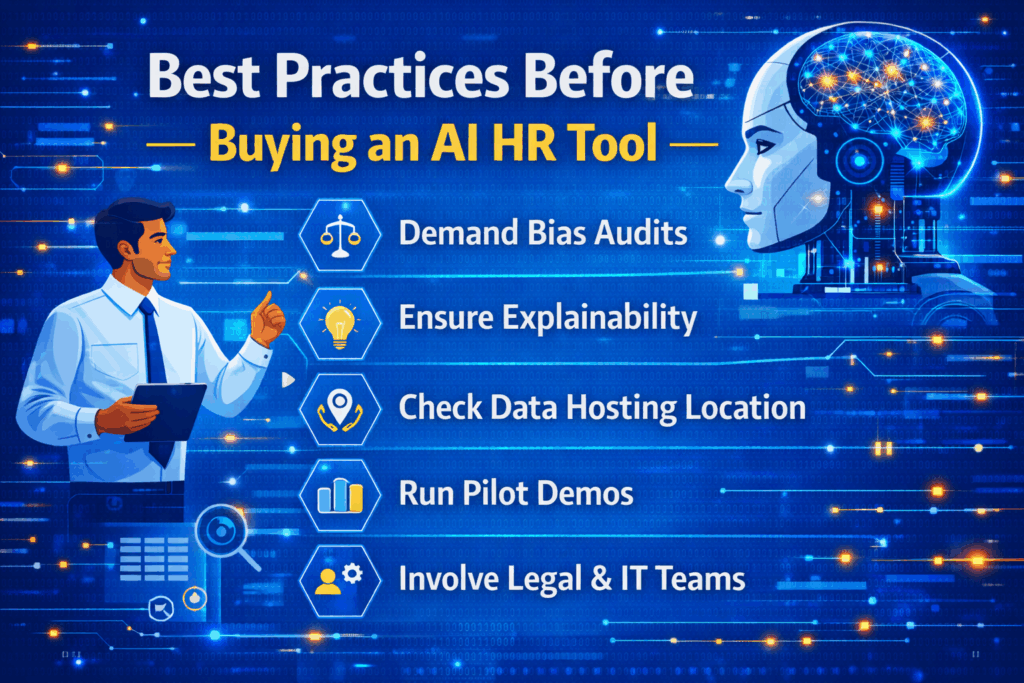
- Ask for bias audits
- Demand explainability
- Check data hosting location
- Run pilot demos
- Involve legal & IT teams
Conclusion
The role of AI in HR is clear: automate what’s repetitive, illuminate what’s hidden, and free HR teams to focus on people—not paperwork.
HR is no longer just a support function. With AI, it becomes a strategic growth engine.
Upskill for the AI-first HR era. Explore our HR automation software for the future of work.
FAQ’s
Is AI replacing HR jobs?
No. AI augments HR professionals, it doesn’t replace them.
Is AI in HR legal in India?
Yes, when used responsibly with data privacy compliance.
How accurate are AI assessments?
Accuracy improves when AI is combined with human review.
Can AI reduce hiring bias?
Yes, if models are audited and designed ethically.
What skills should HR learn for AI adoption?
Data literacy, AI fundamentals, ethics, and change management.
Is AI only for large enterprises?
No. Even mid-size companies can benefit from AI HR tools.
Do employees trust AI in HR?
Transparency and communication are key to trust.