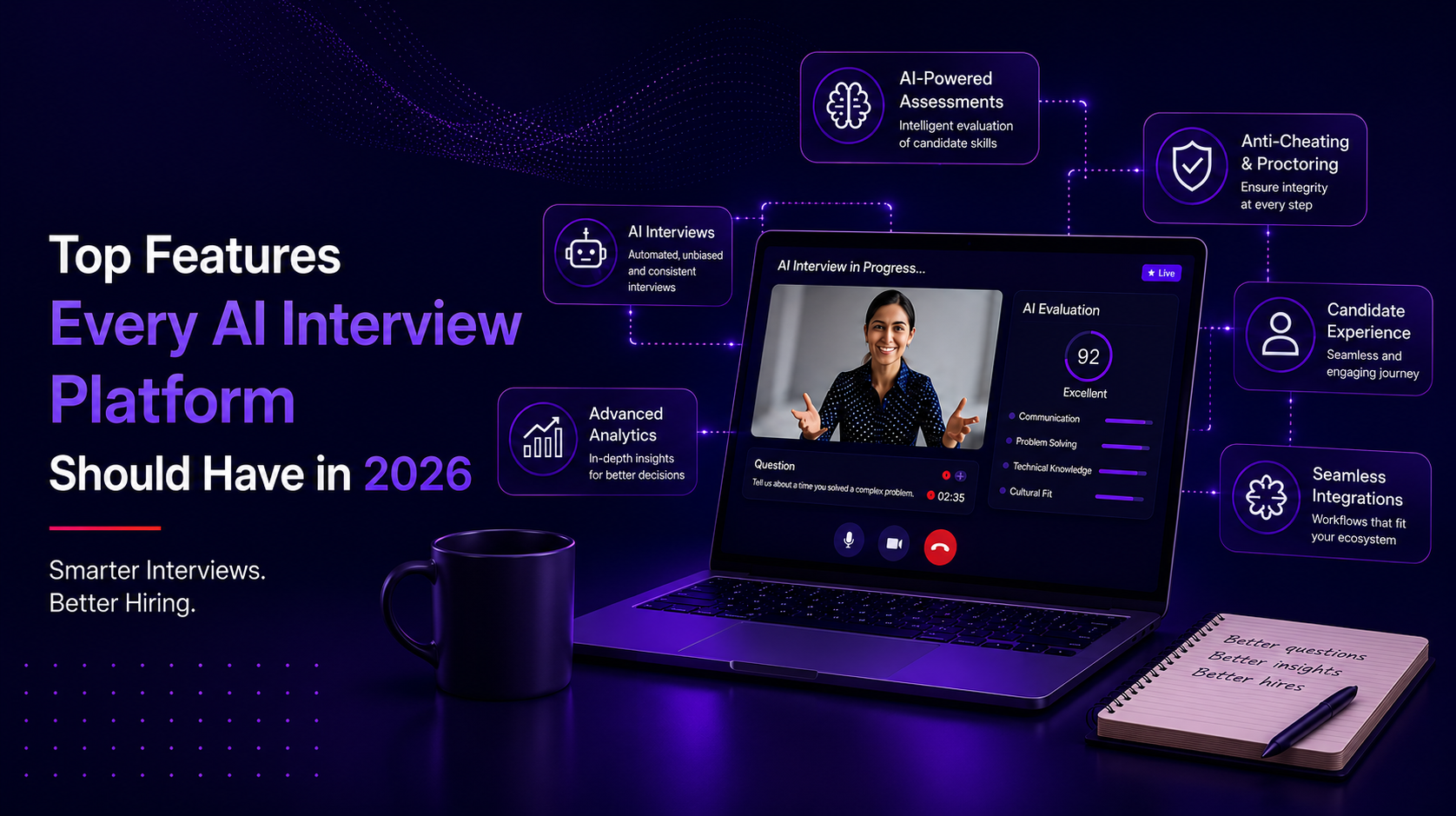
Table of Contents
- Why AI Interview Platforms Are Becoming Essential
- 1. Resume-Based Interview Generation
- 2. AI-Powered Candidate Screening
- 3. Real-Time Candidate Evaluation
- 4. AI Interview Bot for Automated Interviews
- 5. Voice and Video Interview Analysis
- 6. Smart Skill Assessments
- 7. Automated Interview Scheduling
- 8. Advanced Analytics and Recruitment Insights
- 9. Integration with HR and ATS Systems
- 10. Bias Reduction and Ethical AI Hiring
- 11. Multilingual Interview Support
- 12. Mobile-Friendly Candidate Experience
- The Future of AI Interview Platforms
- Conclusion
Hiring has changed completely in the last few years. Recruiters are no longer spending weeks manually screening resumes, scheduling interviews, and evaluating every candidate one by one. Companies today want faster hiring, better candidate quality, and smarter recruitment decisions.
This is exactly where an AI interview platform becomes powerful.
From automated candidate screening to real-time candidate evaluation, AI-powered hiring tools are helping businesses save time, reduce hiring costs, and improve recruitment accuracy. Whether it is a startup, enterprise, HR agency, or remote-first company, AI-driven recruitment is becoming a necessity instead of a luxury.
But not every platform delivers the same results.
Many companies invest in automated interview software only to realise later that the platform lacks important features like resume-based interviews, intelligent assessments, AI interview bots, or analytics.
So, what should businesses actually look for before choosing an AI hiring tool?
In this blog, we will explore the top features every modern AI interview platform should have in 2026 and why these features matter for recruiters, HR teams, and organisations aiming to build stronger teams faster.
Why AI Interview Platforms Are Becoming Essential
Traditional hiring processes are slow and expensive. Recruiters often spend hours reviewing resumes, coordinating interviews, and assessing candidates manually. This creates delays, increases hiring costs, and sometimes leads to poor hiring decisions.
An AI recruitment software solves these problems by automating repetitive hiring tasks and improving decision-making through data-driven insights.
Today’s hiring market is highly competitive. Companies want:
- Faster hiring cycles
- Better candidate experience
- Reduced recruiter workload
- Higher quality hires
- Bias-free evaluation
- Scalable recruitment processes
An advanced AI interview platform helps achieve all these goals.
The rise of remote work, global hiring, and skill-based recruitment has also increased the demand for automated hiring solutions. Businesses now need platforms that can handle high-volume hiring without compromising candidate quality.
That is why modern recruiters are increasingly relying on AI-powered interviews and intelligent screening systems.
1. Resume-Based Interview Generation
One of the most important features every AI interview platform should have is resume-based interview generation.
This feature allows the platform to automatically analyse a candidate’s resume and generate customised interview questions based on their:
- Skills
- Experience
- Projects
- Education
- Industry expertise
Instead of asking generic questions, the platform creates personalised interviews for every candidate.
For example, if a candidate mentions Python, Machine Learning, or SEO experience in their resume, the AI system should generate relevant technical and situational questions automatically.
Why This Feature Matters
Resume-based interviews make the hiring process:
- More relevant
- More engaging
- More skill-focused
- More accurate
Recruiters can better evaluate whether the candidate truly understands the skills mentioned in the resume.
This also improves candidate experience because applicants feel the interview is personalised rather than robotic.
Modern AI hiring tools should use Natural Language Processing (NLP) to understand resumes deeply and generate intelligent follow-up questions automatically.
2. AI-Powered Candidate Screening
Manual resume screening takes a huge amount of recruiter time. An effective candidate screening software should automate this process intelligently.
An AI-powered screening system should be able to:
- Filter candidates based on job requirements
- Match skills with job descriptions
- Identify top candidates instantly
- Rank applicants automatically
- Detect missing qualifications
This feature helps recruiters focus only on high-potential candidates instead of reviewing hundreds of irrelevant applications manually.
Benefits of AI Candidate Screening
Faster Hiring
Recruiters can shortlist candidates within minutes instead of days.
Better Accuracy
AI analyses resumes using predefined criteria, reducing human error.
Improved Scalability
The platform can handle thousands of applications simultaneously.
Reduced Hiring Costs
Less manual effort means lower recruitment expenses.
A strong automated hiring solution should make screening smarter, faster, and more efficient.
3. Real-Time Candidate Evaluation
Modern hiring requires instant insights.
A powerful AI interview platform should offer real-time candidate evaluation during interviews.
This feature analyses candidate responses instantly based on:
- Communication skills
- Technical accuracy
- Confidence
- Problem-solving ability
- Keyword relevance
- Behavioural patterns
Instead of waiting for manual interviewer feedback, recruiters get immediate performance insights.
Why Real-Time Evaluation Is Important
Recruiters often struggle to compare candidates fairly. Real-time evaluation creates a structured scoring system that helps HR teams make faster and more objective decisions.
This feature becomes even more valuable during mass hiring and remote recruitment.
With real-time candidate evaluation, companies can:-
- Reduce interview bias
- Improve hiring consistency
- Make data-driven decisions
- Speed up recruitment workflows
AI-powered hiring platforms in 2026 should provide detailed analytics dashboards with performance scores and candidate comparisons.
4. AI Interview Bot for Automated Interviews
An AI interview bot is now one of the most demanded features in automated interview software.
Instead of scheduling live interviews manually, companies can use AI bots to conduct interviews automatically.
These bots can:
- Ask questions naturally
- Record candidate responses
- Analyse answers in real time
- Conduct voice or video interviews
- Support multilingual communication
How AI Interview Bots Improve Hiring
24/7 Interview Availability
Candidates can complete interviews anytime from anywhere.
Reduced Scheduling Issues
No need to coordinate interviewer availability.
Consistent Interview Process
Every candidate receives the same evaluation structure.
Better Candidate Convenience
Flexible interview timing improves completion rates.
An advanced AI interview bot should also support contextual questioning, where follow-up questions are generated based on candidate answers.
This creates a more natural and engaging interview experience.
5. Voice and Video Interview Analysis
Video recruitment is growing rapidly, especially for remote and hybrid hiring.
A smart AI interview platform should support both voice and video interview analysis.
The platform should analyse:
- Speech clarity
- Tone and confidence
- Communication effectiveness
- Response quality
- Facial expressions (where ethically applicable)
Why This Feature Matters
Recruiters often miss subtle communication insights during high-volume hiring.
AI-powered interviews can identify patterns that help recruiters understand candidate behaviour more effectively.
However, ethical AI usage is extremely important. Platforms should ensure:
- Transparent evaluation methods
- Data privacy compliance
- Bias-free analysis
- Consent-based assessments
Companies are increasingly prioritising ethical AI recruitment practices, making this feature more important in 2026.
6. Smart Skill Assessments
A modern AI hiring tool should not depend only on interviews. It should also offer intelligent skill assessments.
These assessments can include:
- Technical coding tests
- Aptitude assessments
- Role-specific tasks
- Communication evaluations
- Problem-solving challenges
Benefits of Smart Assessments
Better Skill Validation
Recruiters can verify actual candidate capabilities.
Reduced Fake Hiring
Practical assessments reduce resume exaggeration.
Improved Quality Hiring
Companies hire candidates based on real skills, not assumptions.
AI recruitment software should automatically recommend assessments based on job roles and candidate profiles.
This creates a more personalised recruitment process.
7. Automated Interview Scheduling
Interview scheduling is one of the most time-consuming recruitment tasks.
An efficient automated interview software should include smart scheduling capabilities.
The platform should:
- Sync calendars automatically
- Send interview invites
- Manage time zones
- Send reminders
- Allow self-scheduling for candidates
Why Automated Scheduling Matters
This feature saves recruiters significant time and reduces interview no-shows.
For companies handling large recruitment drives, automated scheduling becomes a major productivity booster.
Candidates also appreciate smooth and hassle-free interview coordination.
8. Advanced Analytics and Recruitment Insights
Data-driven hiring is becoming the future of recruitment.
An advanced AI interview platform should provide detailed hiring analytics, such as:
- Candidate performance reports
- Interview completion rates
- Recruitment funnel analysis
- Skill gap identification
- Hiring efficiency metrics
How Analytics Improve Recruitment
Analytics help companies identify:
- Which hiring channels perform best
- Where candidates drop off
- Which skills are most in demand
- How interview processes can improve
Recruiters can continuously optimise hiring strategies using real insights instead of assumptions.
This makes AI recruitment software more strategic and result-oriented.
9. Integration with HR and ATS Systems
A good AI hiring tool should easily integrate with existing HR systems and Applicant Tracking Systems (ATS).
This ensures smooth workflow management without manual data transfer.
The platform should support integration with:
- ATS software
- HRMS platforms
- Calendar tools
- Email systems
- Recruitment CRMs
Why Integration Is Important
Disconnected systems create workflow problems and reduce recruiter efficiency.
Seamless integration helps:
- Centralise candidate data
- Improve collaboration
- Automate workflows
- Reduce administrative tasks
Modern recruitment teams need connected hiring ecosystems for better efficiency.
10. Bias Reduction and Ethical AI Hiring
One of the biggest discussions around AI-powered interviews is hiring bias.
A responsible AI interview platform should focus on ethical hiring practices and bias reduction.
The platform should:
- Use skill-based evaluation
- Avoid demographic discrimination
- Provide transparent scoring systems
- Ensure fair candidate assessment
Why Ethical AI Matters
Companies today are highly focused on diversity, inclusion, and fair hiring practices.
Ethical AI hiring helps:
- Improve workplace diversity
- Build employer trust
- Ensure compliance
- Create fair opportunities for all candidates
AI should support recruiters, not replace human judgment completely.
The best automated hiring solutions combine AI efficiency with human decision-making.
11. Multilingual Interview Support
Global hiring is increasing rapidly.
A modern AI interview platform should support multilingual interviews for candidates from different regions and language backgrounds.
This feature helps companies:
- Hire globally
- Improve candidate accessibility
- Conduct localised recruitment
- Enhance user experience
For Indian companies, especially, multilingual support becomes extremely valuable because candidates often prefer interviews in regional or comfortable languages.
12. Mobile-Friendly Candidate Experience
Candidates today expect everything to work smoothly on mobile devices.
An AI-powered interview platform should provide:
- Mobile interview compatibility
- Responsive dashboards
- Easy assessment access
- Fast loading speed
- Mobile notifications
Why Mobile Experience Matters
A poor mobile experience can increase candidate drop-offs.
Modern recruitment platforms should focus heavily on:
- User experience
- Accessibility
- Simplicity
- Faster interactions
A smooth candidate experience improves employer branding and interview completion rates.
The Future of AI Interview Platforms
AI recruitment technology is evolving rapidly.
In 2026 and beyond, we will see more advanced capabilities such as:
- Conversational AI interviewers
- Predictive hiring analytics
- Behaviour intelligence systems
- AI-based skill forecasting
- Hyper-personalised interviews
Companies that adopt modern AI hiring tools early will gain a strong recruitment advantage.
The future of hiring is not just automation. It is intelligent, scalable, data-driven recruitment that improves both recruiter efficiency and candidate experience.
Conclusion
Hiring the right talent is one of the biggest challenges for modern businesses. Traditional recruitment methods are often slow, expensive, and difficult to scale.
A powerful AI interview platform helps companies streamline hiring with features like:
- Resume-based interviews
- AI interview bots
- Real-time candidate evaluation
- Automated screening
- Smart assessments
- Recruitment analytics
The right automated hiring solution can save time, improve hiring quality, and create a better candidate experience.
As AI-powered interviews continue to evolve, businesses must choose platforms that focus on accuracy, scalability, ethics, and user experience.
If you are looking for a smarter way to hire candidates faster and more efficiently, now is the right time to explore AI-driven recruitment technology.
Visit AI Interview and discover how intelligent hiring solutions can transform your recruitment process.