Table of Contents
- Why HR Recruiter Skills Matter More Than Ever
- A Short Story That Shows the Impact of Recruiter Skills
- What Are the Most Important HR Recruiter Skills?
- How to Build HR Recruiter Skills: A Step-by-Step Plan
- HR Recruiter Skills for Resume (Ready-to-Use Bullets)
- Hiring Manager Perspective: What They Actually Care About
- A Practical Skills-Based Hiring Framework (SKILLS Framework)
- HR Recruiter Skills Checklist
- Conclusion & CTA: Take Your Recruiter Skills to the Next Level
- FAQs
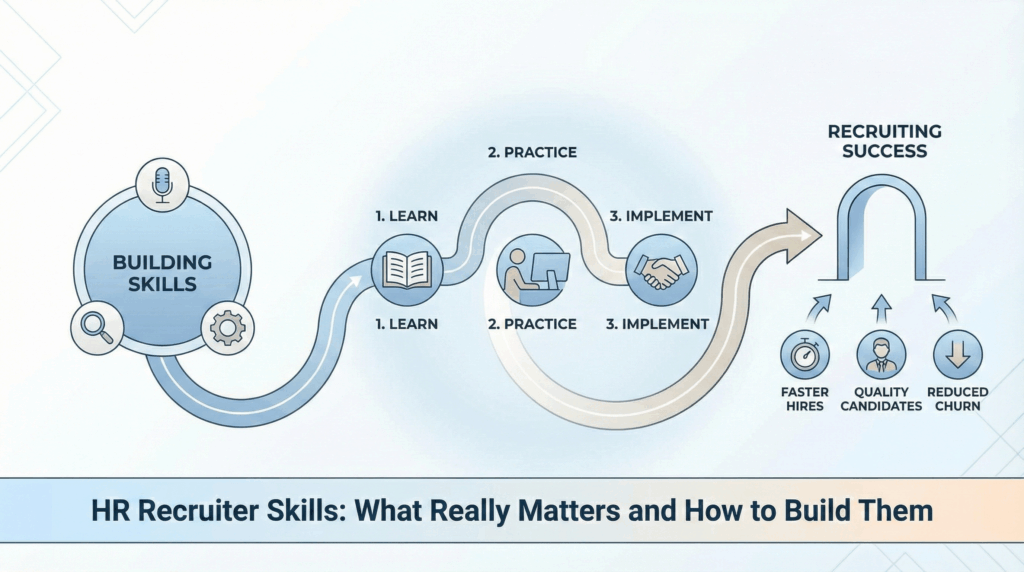
A hiring mistake can cost up to 30% of a candidate’s first-year salary — sometimes more. Yet most recruitment challenges boil down to one thing: the skills of the HR recruiter managing the hiring process. When skills are sharp, organisations hire faster, hire better, and reduce churn. When they aren’t, even a strong employer brand cannot save the process.
This guide breaks down the HR recruiter skills that truly matter today, how to build them, and how to stay relevant in a skills-based hiring world.
Why HR Recruiter Skills Matter More Than Ever
Recruiting has changed dramatically. Hiring managers expect data, candidates expect clarity, and companies expect quality hires who ramp up fast. Traditional hiring approaches no longer work.
As noted by AI Interview and other HR research platforms, today’s recruiters must combine interpersonal skills, sourcing expertise, assessment capabilities, technical tools, and business understanding — while managing high-speed hiring cycles.
A well-rounded recruiter can:
- Reduce time-to-hire by 20–40%
- Improve candidate satisfaction scores
- Strengthen internal alignment with hiring managers
- Build long-term talent pipelines instead of scrambling for every role
When the right skills are in place, hiring becomes predictable and scalable.
A Short Story That Shows the Impact of Recruiter Skills
Last year, an HR recruiter at a mid-size tech firm struggled with closing positions on time. She received strong CVs, but almost every candidate dropped off mid-process. After reviewing her workflow, she realised the issue wasn’t sourcing — it was communication. She wasn’t setting expectations or guiding candidates clearly. By improving her messaging templates, follow-up rhythm, and screening scripts, her offer-accept ratio increased by 32% within one quarter.
One skill. Major impact.
What Are the Most Important HR Recruiter Skills?
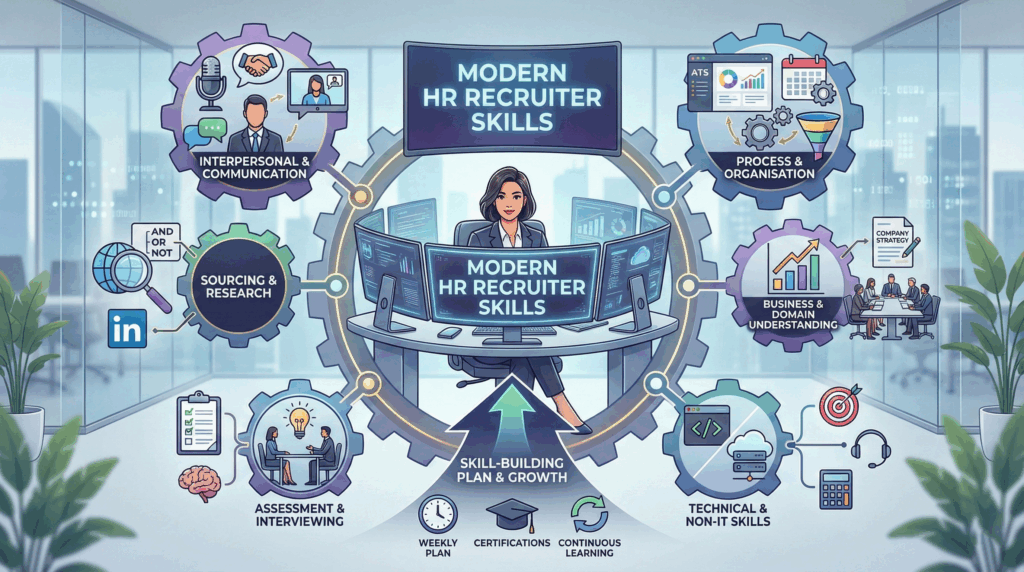
1. Interpersonal & Communication Skills
Strong communication is at the heart of every successful recruiter. This includes writing clear JDs, having confident conversations, and influencing hiring managers.
Key Components
- Structured communication (JD writing, emails, messages)
- Candidate engagement skills
- Rapport-building with stakeholders
- Handling objections and salary negotiations
Micro-actions
- Rewrite one job description each week using clarity-first principles.
- Practise 10–12 mock screening calls with teammates monthly.
2. Sourcing & Research Skills
Recruiters must know where and how to find the right people — especially for competitive roles like tech, analytics, and product.
Key Components
- Boolean search expertise
- Knowledge of job boards, LinkedIn, niche platforms
- Talent intelligence (competition research, salary benchmarks)
Micro-actions
- Build 3 new Boolean strings weekly (IT and non-IT).
- Study 5 competitors’ hiring patterns monthly.
3. Assessment & Interviewing Skills
Modern recruiters need to screen for skills, potential, and culture fit — without relying on gut feeling.
Key Components
- Skills-based hiring frameworks
- Behavioural interviewing
- Screening assessments
- Understanding technical skills for recruiter roles (basic tech literacy for IT roles)
As TestGorilla highlights, objective assessments greatly improve hiring outcomes.
Micro-actions
- Add 3 skill-based questions to every screening call.
- Review one candidate performance pattern weekly with hiring managers.
4. Process & Organisation Skills
A recruiter’s workflow must be structured and reliable.
Key Components
- Pipeline management
- ATS/software skills
- Documentation and compliance
- Coordinating interview panels
- Tracking conversion ratios (sourcing → screening → shortlist → selection → joining)
Micro-actions
- Block two 30-minute weekly slots for pipeline clean-up.
- Track three key metrics consistently: time-to-hire, offer-accept ratio, and source effectiveness.
5. Business & Domain Understanding
Recruiters who understand the business can evaluate candidates better and partner effectively with hiring managers.
Key Components
- Understanding product/service
- Learning role requirements
- Knowing competitive landscape
- Translating hiring needs into profiles
Micro-actions
- Attend one product demo or team meeting weekly.
- Create 1–page hiring briefs for every new role.
6. Technical Recruiter Skills (For IT & Tech Hiring)
Technical recruiters must understand the basics of:
- Programming languages & frameworks
- Databases
- Cloud basics
- Agile methodologies
- DevOps/SRE fundamentals
Micro-actions
- Spend 20–30 minutes daily reviewing job descriptions for tech roles.
- Use YouTube/LinkedIn Learning to understand one new technical term each week.
7. Non-IT Recruitment Skills
Non-tech roles require empathy, behavioural understanding, and role-specific screening.
Key skill areas include:
- Sales competency screening
- HR/finance role understanding
- Customer support personality mapping
- Leadership potential assessment
Micro-actions
- Build question banks for common non-IT roles.
- Shadow one manager interview per month.
How to Build HR Recruiter Skills: A Step-by-Step Plan
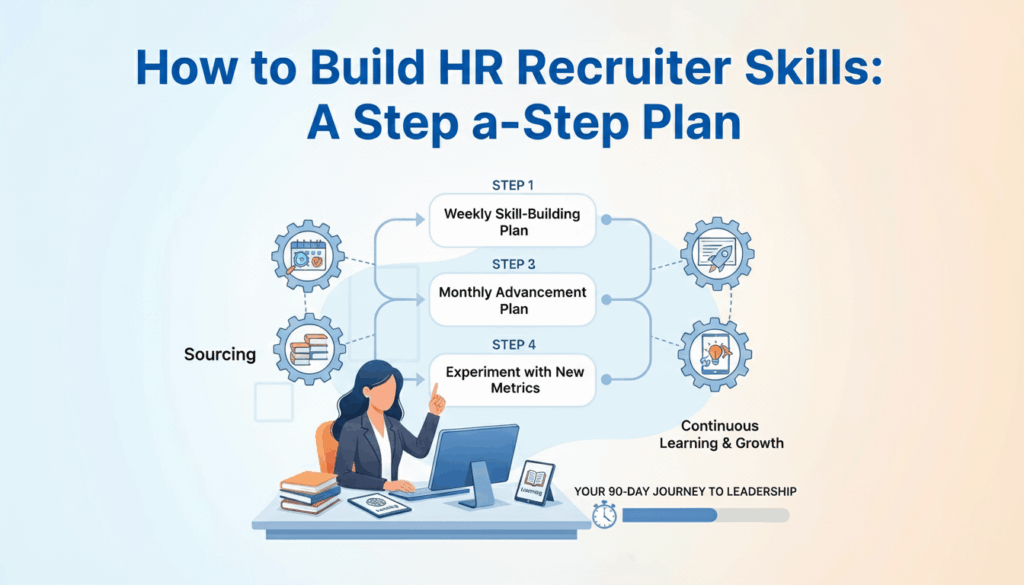
1. Weekly Skill-Building Plan
- 2 hours: Improve sourcing (Boolean practice, new platforms)
- 1 hour: Interview practice
- 2 hours: Business learning (team meetings, demos)
- 1 hour: Data and ATS hygiene
- 30 minutes: JD rewriting and clarity checks
Total: 6.5 hours weekly — enough to significantly improve performance over 90 days.
2. Monthly Advancement Plan
- Shadow hiring managers
- Take one short certification
- Review hiring funnel metrics
- Update skill-based hiring templates
- Experiment with new tools (AIInterview, ATS filters, assessments)
HR Recruiter Skills for Resume (Ready-to-Use Bullets)
Use these bullet points to strengthen your CV:
- Led end-to-end hiring for tech and non-tech roles, reducing time-to-hire by X%.
- Built sourcing pipelines using Boolean search and LinkedIn Recruiter.
- Conducted 100+ behavioural and skills-based interviews annually.
- Improved offer-accept ratio by X% through structured candidate engagement.
- Partnered with hiring managers to create role briefs and hiring plans.
- Implemented ATS-driven workflows for higher recruiter productivity.
- Used data insights to optimise sourcing channels and recruitment KPIs.
- Managed IT recruitment cycles, evaluating candidates across key technical skills.
Hiring Manager Perspective: What They Actually Care About
Hiring managers want recruiters who:
1. Understand the role
Not just keywords — but context, outcomes, KPIs.
2. Bring qualified candidates, not volume
Quality beats quantity every time.
3. Communicate clearly
No surprises. Clear timelines. Structured documentation.
4. Use data
Metrics they value:
- Quality of hire
- Interview-to-offer ratio
- Offer-accept ratio
- Candidate dropout reasons
How to Show This
- Share weekly hiring dashboards
- Present top 3 candidate insights
- Speak the manager’s language (role requirements, project goals)
Micro-action: Start sending weekly hiring snapshots — even if short.
A Practical Skills-Based Hiring Framework (SKILLS Framework)
Use this 7-step approach to modern hiring:
S – Scorecards: Define skills, behaviours, KPIs
K – Knowledge: Role understanding + domain basics
I – Interviewing: Structured, behavioural, role-based
L – Listening: Candidate signals + manager expectations
L – Learning: Constant improvement through feedback
S – Screening Tools: Tests, assessments, assignments
Micro-action: Build one new scorecard each week.
HR Recruiter Skills Checklist
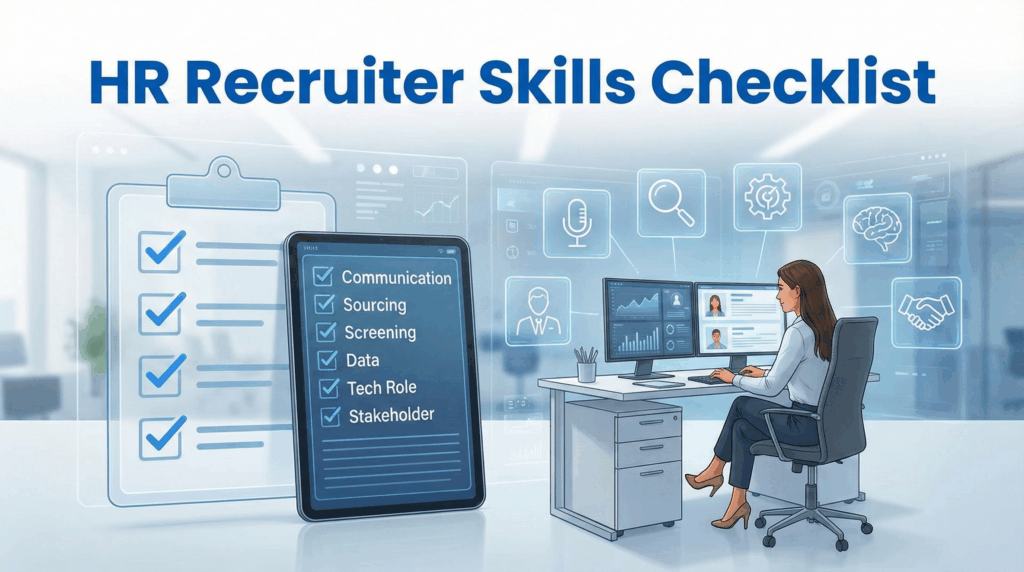
- Strong written & verbal communication
- Boolean search & sourcing mastery
- Skills-based screening expertise
- Tech & non-tech role understanding
- ATS & recruitment tools proficiency
- Pipeline organisation
- Data-driven decision-making
- Candidate engagement & nurturing
- Negotiation skills
- Stakeholder management
Conclusion & CTA: Take Your Recruiter Skills to the Next Level
Building strong HR recruiter skills is no longer optional — it’s the foundation of modern hiring. With skills-based hiring becoming the standard, recruiters who upgrade themselves will grow faster, achieve better outcomes, and position themselves as strategic partners in the organisation.
If you’re ready to level up:
- Book a demo of AIInterview (affordable ai recruiting tools) to automate screening and skill assessments
FAQs
1. What are the top HR recruiter skills today?
Communication, sourcing, interviewing, organisation, and business understanding are the most critical skills recruiters need.
2. What are technical recruiter skills?
These include understanding programming basics, tech stacks, cloud concepts, and evaluating technical profiles accurately.
3. What skills should HR recruiters list on their resumes?
Skills such as sourcing, ATS proficiency, skills-based hiring, stakeholder management, and interviewing techniques.
4. What are non-IT recruitment skills?
Screening for soft skills, behavioural indicators, and functional capabilities for roles in sales, HR, finance, operations, and customer service.
5. How can recruiters become better at skills-based hiring?
Use scorecards, structured interviewing, assessments, and consistent evaluation across candidates.