Table of Contents
- HR doesn’t run on policies alone. It runs on operations.
- What Is HR Operations? (HR Operations Meaning)
- Why HR Operations Is Critical for Every Organisation
- HR Operations Roles and Responsibilities
- HR Operations vs HR Generalist vs HR Business Partner
- HR Operations Job Description (Sample Overview)
- HR Operations Jobs: Roles You Can Apply For
- Skills Required for a Career in HR Operations
- Future of HR Operations: Where the Role Is Heading
- Final Thoughts: Is HR Operations the Right Career for You?
HR doesn’t run on policies alone. It runs on operations.
Hiring great talent is important. Building culture matters.
But none of it works if HR operations fail.
Payroll delays, broken onboarding, compliance gaps, missing employee records — these aren’t “small issues.” They directly hit trust, productivity, and business continuity.
That’s where HR Operations comes in.
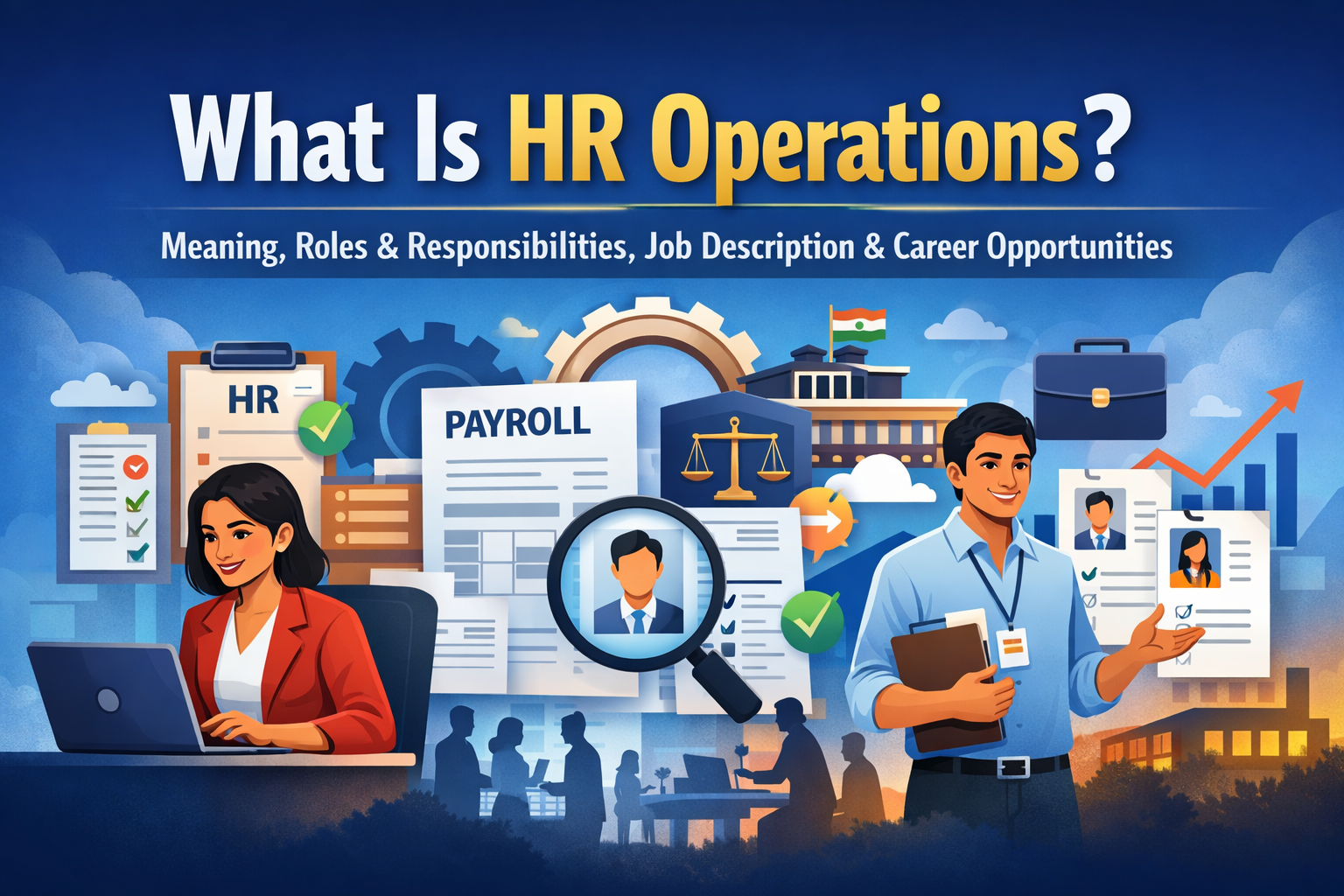
In this guide, we’ll break down what HR operations really mean, what HR operations teams do daily, job roles and responsibilities, career opportunities, and why HR operations is becoming one of the most stable and in-demand HR careers in India.
Whether you’re an HR professional, a fresher, or someone planning a career switch — this is your complete roadmap.
What Is HR Operations? (HR Operations Meaning)
HR Operations refers to the executional and administrative backbone of Human Resources.
If HR strategy decides what needs to be done, HR operations ensure it actually gets done — accurately, on time, and at scale.
In simple terms:
HR Operations is responsible for managing people processes, employee lifecycle tasks, compliance, systems, and HR service delivery.
It focuses on process efficiency, compliance, data accuracy, and employee experience, not high-level planning or talent branding.
HR Operations Meaning in Practical Language
HR Operations simply means making sure all employee-related work runs smoothly, correctly, and on time inside an organisation.
It is the part of HR that takes care of the actual execution of people processes — not planning, not strategy, but real, everyday work that employees and businesses depend on.
In practical terms:
HR Operations ensures that employees are hired properly, paid correctly, supported daily, and exit smoothly — while the company stays legally compliant.
Think of HR Operations Like This
If HR is a system:
- Strategy decides what needs to be done
- HR Operations makes sure it actually happens without errors
What HR Operations Handles in Real Life
On a normal working day, HR operations deals with:
- Issuing offer letters and appointment letters
- Collecting and verifying employee documents
- Managing attendance, leaves, and holidays
- Processing monthly payroll and payslips
- Handling PF, ESI, gratuity, and labour law compliance
- Answering employee queries related to salary, leave, or policies
- Managing HR software and employee records
Why HR Operations Is So Important
Employees may never see HR operations directly, but they feel it immediately when something goes wrong:
- Salary credited late
- Wrong deductions in payslip
- Leave balance not updated
- Offer letter delays
All of these are HR operations issues.
In One Line
“HR Operations is the backbone of HR — it keeps people processes stable, compliant, and dependable so employees can focus on their work and businesses can scale confidently.”
HR operations handle:
- Employee onboarding & exits
- Payroll & benefits administration
- Attendance, leave & records
- HR compliance & statutory filings
- HR systems (HRMS, ATS, payroll tools)
- HR helpdesk & employee queries
Without HR operations, even the best HR strategy collapses.
Why HR Operations Is Critical for Every Organisation
Many companies underestimate HR operations — until something breaks.
Here’s why HR operations matter more than ever:
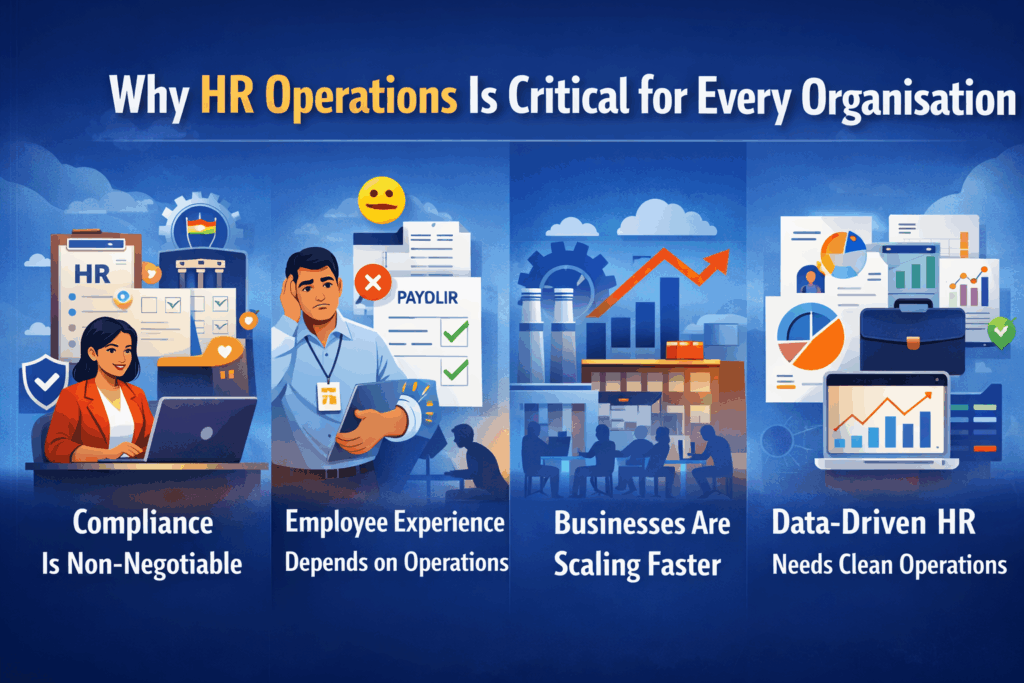
1. Compliance Is Non-Negotiable
India has complex labour laws — PF, ESI, Gratuity, Shops & Establishment Acts, payroll tax rules.
HR operations ensure zero compliance risk.
2. Employee Experience Depends on Operations
Late salaries, incorrect payslips, missing offer letters — these are operational failures, not cultural ones.
3. Businesses Are Scaling Faster
Startups and enterprises alike need standardised HR processes to scale teams quickly and safely.
4. Data-Driven HR Needs Clean Operations
HR analytics only works when HR data is accurate — which is an HR operations responsibility.
HR Operations Roles and Responsibilities
HR operations roles and responsibilities vary by company size, but the core functions remain consistent.
1. Employee Lifecycle Management
- Issuing offer letters & contracts
- Background verification coordination
- Onboarding documentation & induction
- Exit formalities & full-and-final settlement
2. Payroll & Compensation Operations
- Monthly payroll processing
- Variable pay & incentives coordination
- Payslip generation & salary disbursement
- Payroll audits & corrections
3. Compliance & Statutory Management
- PF, ESI, Professional Tax
- Labour law documentation
- Statutory filings & audits
- Handling inspections & notices
4. HR Systems & Tools Management
- HRMS configuration & maintenance
- Attendance & leave systems
- Employee data management
- System access provisioning
5. HR Service Delivery & Helpdesk
- Resolving employee queries
- Policy clarifications
- Payroll & leave issue resolution
- Inter-department coordination
6. HR Process Optimisation
- SOP creation & documentation
- Process automation
- Vendor management (payroll, insurance)
- Continuous improvement initiatives
HR Operations vs HR Generalist vs HR Business Partner
Many professionals confuse these roles. Here’s a simple comparison:
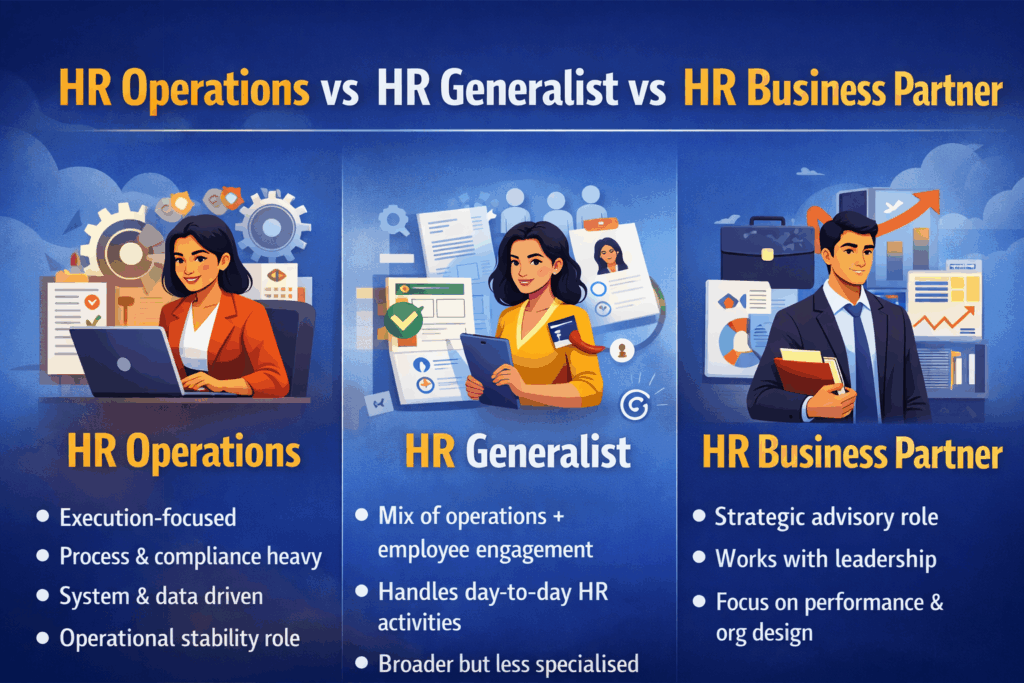
HR Operations
- Execution-focused
- Process & compliance heavy
- System & data driven
- Operational stability role
HR Generalist
- Mix of operations + employee engagement
- Handles day-to-day HR activities
- Broader but less specialised
HR Business Partner (HRBP)
- Strategic advisory role
- Works with leadership
- Focus on performance & org design
HR operations is often the foundation on which HR generalist and HRBP careers are built.
HR Operations Job Description (Sample Overview)
Here’s what a typical HR Operations Job Description includes:
Role: HR Operations Executive / Specialist
Experience: 1–6 years
Location: PAN India
Key Responsibilities:
- Manage end-to-end employee lifecycle operations
- Process payroll and coordinate statutory compliance
- Maintain accurate HR records and databases
- Handle employee queries and HR helpdesk
- Ensure adherence to HR policies and labour laws
- Coordinate with vendors and internal teams
- Support audits and reporting requirements
Required Skills:
- Strong attention to detail
- Knowledge of labour laws & payroll
- HRMS / Excel proficiency
- Process orientation
- Clear communication skills
HR Operations Jobs: Roles You Can Apply For
HR operations offers clear, structured career roles:
Entry-Level Roles
- HR Operations Executive
- HR Coordinator
- Payroll Executive
- HR Administrator
Mid-Level Roles
- HR Operations Specialist
- Payroll & Compliance Manager
- HR Shared Services Lead
Senior Roles
- HR Operations Manager
- Head of HR Operations
- Global HR Operations Lead
Many professionals move into HR analytics, HRBP, or people operations leadership from HR operations.
Skills Required for a Career in HR Operations
To grow in HR operations, you need a blend of technical accuracy and people handling.
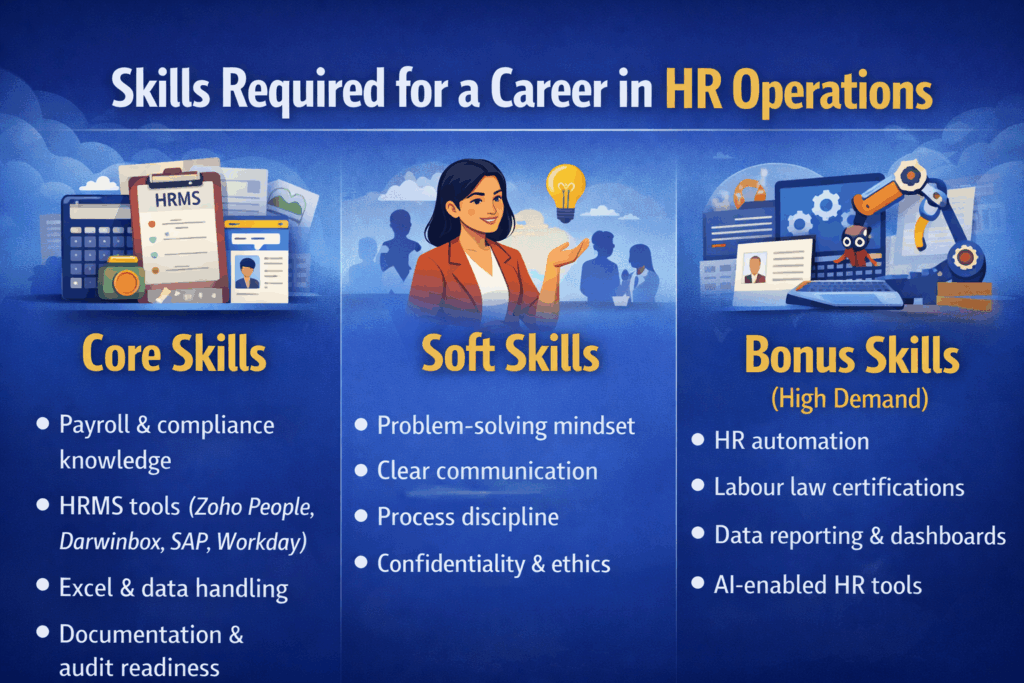
Core Skills
- Payroll & compliance knowledge
- HRMS tools (Xgenplus Mobile Attendance & Tracking System)
- Excel & data handling
- Documentation & audit readiness
Soft Skills
- Problem-solving mindset
- Clear communication
- Process discipline
- Confidentiality & ethics
Bonus Skills (High Demand)
- HR automation
- Labour law certifications
- Data reporting & dashboards
- AI-enabled HR tools
Career Opportunities & Salary in HR Operations (India)
HR operations is one of the most stable HR career tracks.
Salary Range (Approx.)
- Fresher: ₹2.5 – ₹4.5 LPA
- Mid-Level: ₹6 – ₹10 LPA
- Senior Roles: ₹12 – ₹25+ LPA
With global HR shared services and MNC demand, HR operations roles are growing fast — especially in BFSI, IT, SaaS, healthcare, and manufacturing sectors.
Future of HR Operations: Where the Role Is Heading
HR operations is no longer just admin work.
The future includes:
- AI-powered payroll & compliance
- Self-service HR portals
- HR analytics & dashboards
- Automation of repetitive tasks
- Global HR shared services models
Professionals who combine process expertise + technology will lead the next decade of HR.
Final Thoughts: Is HR Operations the Right Career for You?
If you enjoy:
- Structured work
- Process clarity
- Operational excellence
- Business-critical responsibility
Then HR operations is not a backup role — it’s a powerful career path.
Strong HR operations professionals are invisible when things run smoothly — but absolutely indispensable when they don’t.
Hiring for HR Operations roles? Make smarter decisions with AIInterview.
Explore AIInterview to assess real-world HR operations skills, screen candidates faster, and hire with confidence using AI-driven interviews built for modern HR teams.
👉 Explore AIInterview for hiring today and build a stronger HR operations team.