Table of Contents
- What Is Employee Engagement?
- Employee Engagement Meaning: Why It’s More Than Satisfaction
- Why Employee Engagement Matters
- Types of Employee Engagement
- Employee Engagement in HR and HRM: What It Really Means
- Measurable Indicators of Employee Engagement
- Proven Employee Engagement Strategies That Actually Work
- Employee Engagement Activities & Ideas
- A Simple Employee Engagement Framework for HR Teams
- Common Employee Engagement Mistakes to Avoid
- The Real Bottom Line
- Conclusion & Call to Action
- Frequently Asked Questions
If your people show up every day but don’t really show up at work, you don’t have a performance problem — you have an employee engagement problem.
Across Indian workplaces, from fast-growing startups to legacy enterprises, HR leaders are asking the same question: How do we build a workforce that is motivated, committed, and willing to go the extra mile? The answer lies in understanding employee engagement — and acting on it, consistently.
This guide breaks down what is employee engagement, its meaning, types, practical strategies, and how employee engagement in HR and HRM actually works on the ground. No fluff. No jargon. Just clear, actionable insight you can use.
What Is Employee Engagement?
Employee engagement refers to the emotional, cognitive, and behavioural commitment an employee has toward their organisation and its goals.
In simple terms, employee engagement means how invested people feel in their work, their team, and the company’s success — not just whether they are satisfied or paid on time.
According to Experts, engaged employees care deeply about their work, feel aligned with organisational goals, and are motivated to contribute beyond their job description. This definition is widely accepted in modern HR practice and research.
What is employee engagement really about?
Not perks. Not ping-pong tables. It’s about purpose, trust, growth, and recognition — experienced daily.
Employee Engagement Meaning: Why It’s More Than Satisfaction
Many organisations confuse employee satisfaction with employee engagement. They’re not the same.
| Satisfaction | Engagement |
| “I’m okay with my job.” | “I care about my job.” |
| Transactional | Emotional + behavioural |
| Short-term | Long-term |
| Reactive | Proactive |
An employee can be satisfied but disengaged — doing just enough to get by. Engaged employees, on the other hand, think, feel, and act in ways that push the organisation forward.
Why Employee Engagement Matters
In the Indian context, employee engagement has become mission-critical due to:
- High attrition in IT, GCCs, and startups
- Multi-generational workforce expectations
- Hybrid and remote work challenges
- Rising competition for skilled talent
Research consistently shows that engaged employees deliver better outcomes. Studies have highlighted that higher engagement is linked to improved productivity, lower absenteeism, and stronger employee retention.
The cost of disengagement is real:
Lower morale → higher attrition → hiring costs → loss of knowledge → weaker customer experience.
Types of Employee Engagement
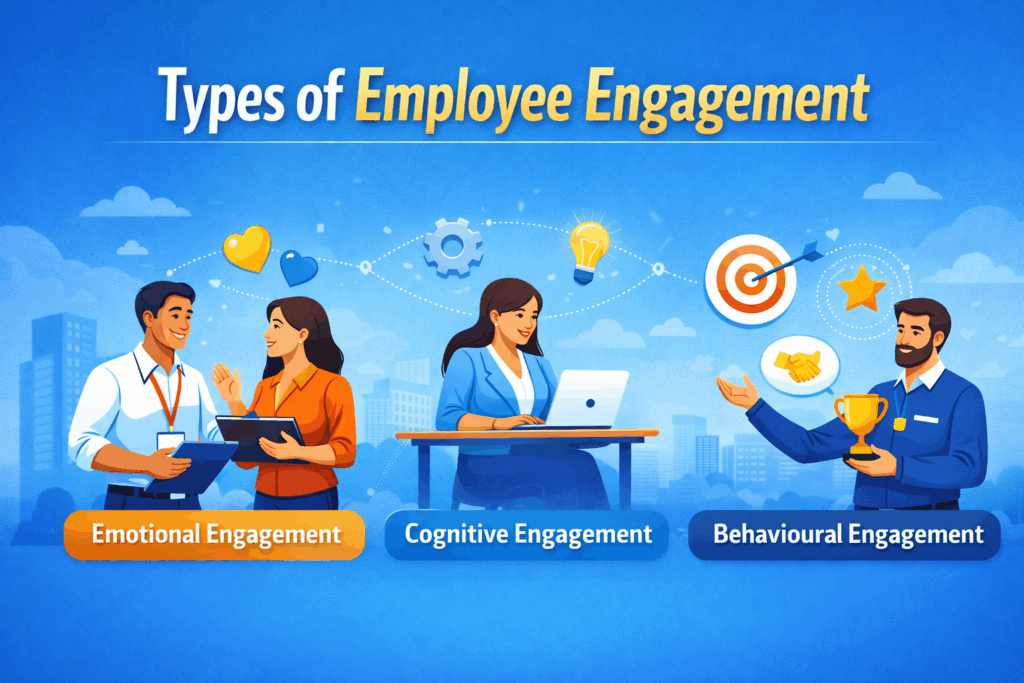
Understanding the types of employee engagement helps HR teams diagnose where the problem lies and what to fix.
1. Emotional Engagement
Employees feel connected to the organisation’s purpose and values.
Signals:
- Pride in the company
- Strong sense of belonging
- Willingness to recommend the organisation
2. Cognitive Engagement
Employees are mentally invested in their work.
Signals:
- Focus and problem-solving
- Curiosity and innovation
- Desire to improve processes
3. Behavioural (Physical) Engagement
Employees demonstrate engagement through actions.
Signals:
- Taking initiative
- Collaborating proactively
- Going beyond role requirements
Strong employee engagement happens when all three types align.
Miss one, and performance starts to dip.
Employee Engagement in HR and HRM: What It Really Means
Employee Engagement in HR
Employee engagement in HR focuses on designing policies, experiences, and practices that keep employees motivated and committed.
HR’s role includes:
- Listening to employees (surveys, pulse checks)
- Enabling managers
- Building trust through fair policies
- Creating growth and recognition systems
Employee Engagement in HRM (Human Resource Management)
Employee engagement in HRM integrates engagement across the entire employee lifecycle:
- Hiring the right cultural fit
- Onboarding with clarity and purpose
- Continuous learning and performance management
- Recognition, wellbeing, and career progression
- Respectful exits and alumni relationships
In short, engagement is not an HR initiative — it’s an HR mindset.
Measurable Indicators of Employee Engagement
You can’t improve what you don’t measure. Common employee engagement indicators include:
- Engagement survey scores
- eNPS (Employee Net Promoter Score)
- Attrition and retention rates
- Absenteeism
- Productivity and performance trends
- Internal mobility and learning participation
Pro tip: Annual surveys are not enough. Pulse surveys (monthly or quarterly) give faster insights.
Proven Employee Engagement Strategies That Actually Work
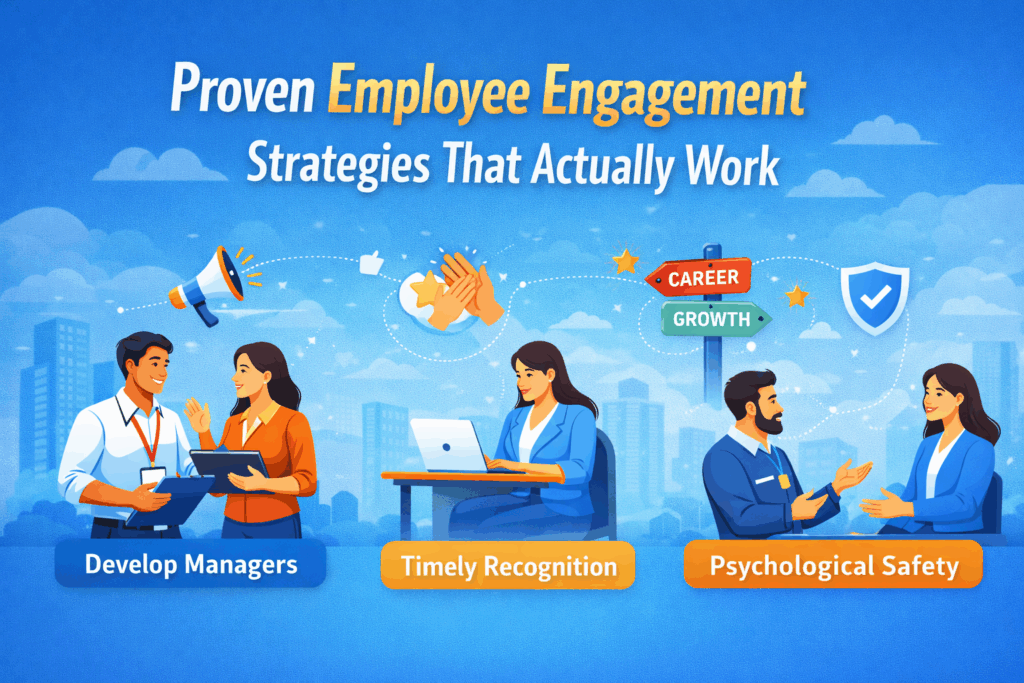
Employee engagement doesn’t improve because of posters on the wall or one-off fun activities. It improves when employees feel heard, valued, and supported in their everyday work. The strategies below are not theoretical models — they are practical actions that organisations can apply and sustain, especially in real-world Indian workplaces.
1. Develop Managers, Not Just Policies
One of the biggest drivers of employee engagement is the direct manager. Even the best HR policies fail if managers don’t know how to lead people.
What works in practice:
- Train managers to have regular, meaningful conversations with their team members
- Encourage honest feedback, not just performance updates
- Evaluate managers on team morale and engagement, not only on targets
When managers listen, guide, and support employees consistently, engagement improves naturally.
2. Make Recognition Timely and Genuine
Employees don’t disengage because they want rewards; they disengage because their efforts feel invisible.
Effective recognition doesn’t need a big budget. It needs sincerity.
- Appreciate good work when it happens, not months later
- Be specific about what was done well and why it mattered
- Encourage peer-to-peer appreciation, not only top-down praise
Simple, regular recognition builds trust and motivates employees to put in discretionary effort.
3. Provide Clear Growth and Career Direction
A major reason employees lose interest is the feeling of being stuck. When people don’t see a future, they stop investing emotionally in the present.
To address this:
- Clearly communicate career paths and role expectations
- Offer learning opportunities linked to real skill development
- Promote internal mobility instead of hiring externally for every role
When employees see growth possibilities, they stay engaged even during challenging phases.
4. Build Psychological Safety at Work
Employees engage more when they feel safe to express ideas, concerns, and even mistakes without fear.
Practical steps include:
- Encouraging open discussions in team meetings
- Creating anonymous channels for honest feedback
- Treating mistakes as learning opportunities, not failures
A psychologically safe environment leads to better collaboration, innovation, and accountability.
5. Support Wellbeing Beyond Words
Post-pandemic workplaces have made one thing clear — burnout directly affects engagement. Employees cannot stay motivated if they are constantly exhausted.
What actually helps:
- Flexible working arrangements where possible
- Realistic workload expectations
- Access to mental health and wellbeing support
When organisations respect personal boundaries and health, employees reciprocate with commitment and loyalty.
The Key Takeaway
There is no single formula for employee engagement. What works is consistency. Small, everyday actions — when done with genuine intent — create far more impact than grand initiatives that fade away.
Engagement grows when employees feel respected as people, not just managed as resources.
Employee Engagement Activities & Ideas
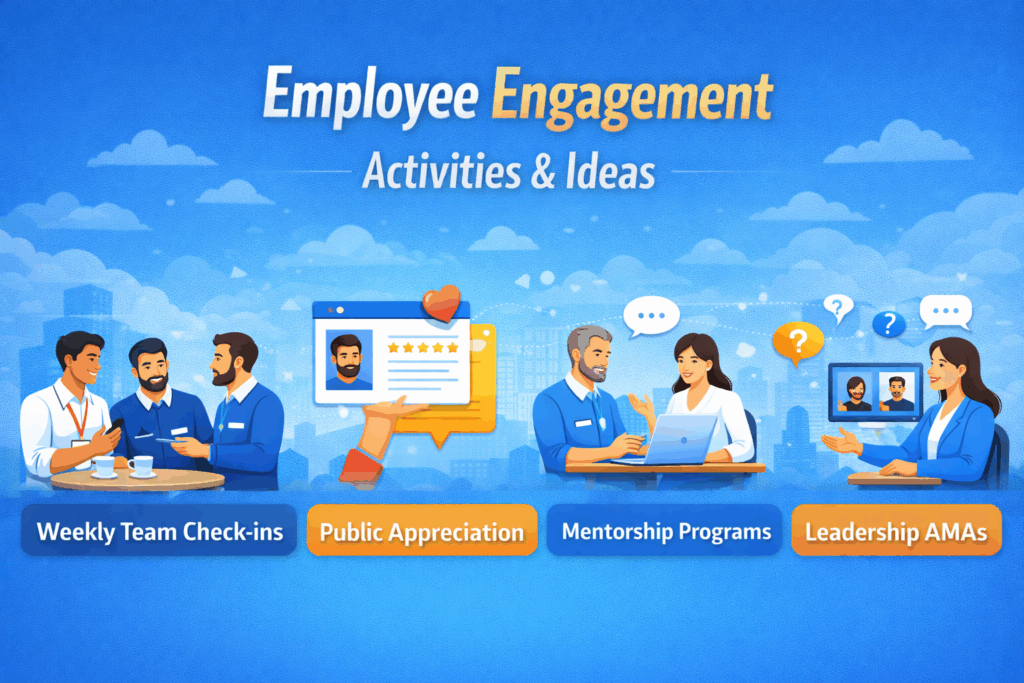
Here are employee engagement activities and ideas that work across team sizes and budgets.
Quick-Win Employee Engagement Activities
| Activity | Time | Impact |
| Weekly team check-ins | 15 mins | Medium |
| Public appreciation posts | Instant | High |
| Employee spotlight stories | Monthly | Medium |
| Pulse surveys | 5 mins | High |
Long-Term Employee Engagement Ideas
| Activity | Effort | Impact |
| Mentorship programs | Medium | High |
| Leadership AMAs | Low | High |
| Learning stipends | Medium | High |
| Cross-functional projects | Medium | Very High |
A Simple Employee Engagement Framework for HR Teams
Use this 5-step checklist to implement engagement systematically:
- Listen – Surveys, feedback, exit insights
- Diagnose – Identify engagement gaps by team
- Design – Choose targeted strategies
- Enable – Equip managers and HR
- Measure & Iterate – Track progress quarterly
Treat engagement like a product: test, learn, improve.
Common Employee Engagement Mistakes to Avoid
- One-time engagement events
- Ignoring manager capability
- Surveying without acting
- Copy-pasting engagement ideas from other companies
- Assuming money alone drives engagement
The Real Bottom Line
Employee engagement is not an HR trend — it’s a business necessity.
When employees are engaged:
- Performance improves
- Attrition reduces
- Culture strengthens
- Customers feel the difference
If you want sustainable growth, invest in engagement — daily, deliberately, and authentically.
Conclusion & Call to Action
Employee engagement doesn’t begin after joining — it starts with smart hiring and efficient HR processes. When organisations hire the right talent and remove manual, time-consuming HR work, employees feel more aligned, supported, and engaged from day one.
A smart hire and HR automation tool like AIInterview.in helps HR teams streamline hiring, conduct structured and unbiased interviews, and automate key HR workflows — all while improving the overall candidate and employee experience. By combining technology with people-centric practices, AIInterview.in enables HR teams to focus less on operations and more on building strong, engaged teams.
If you want to improve employee engagement, reduce hiring inefficiencies, and build a future-ready workforce, now is the time to upgrade your HR approach.
👉 Visit AIInterview.in and experience smarter hiring with powerful HR automation.
Frequently Asked Questions
What is employee engagement in simple words?
Employee engagement is how emotionally and mentally connected employees feel to their work and organisation.
Why is employee engagement important in HR?
It directly impacts retention, performance, culture, and long-term business success.
What are the main types of employee engagement?
Emotional, cognitive, and behavioural (physical) engagement.
How can HR improve employee engagement?
By empowering managers, recognising employees, offering growth opportunities, and listening consistently.
What are some low-cost employee engagement activities?
Peer recognition, regular check-ins, pulse surveys, and employee spotlights.