
Table of Contents
- What Is an HR Generalist? (HR Generalist Meaning)
- HR Generalist Job Description (What Companies Actually Expect)
- HR Generalist Roles & Responsibilities
- HR Generalist Salary in India
- HR Generalist Resume Guide (Resume & CV Examples)
- Key HR Generalist Skills
- Common HR Generalist Interview Questions
- Career Growth After HR Generalist
- Final Takeaway
If you ask ten people in HR what an HR generalist actually does, you’ll get ten slightly different answers.
And that’s not a bad thing.
Because the truth is: the HR generalist role isn’t about one fixed job description. It’s about holding the centre of the organization together—quietly, consistently, and often without much visibility.
This guide explains the real meaning of an HR generalist, what the role actually involves on the ground, how much HR generalists earn in India, and how to write a resume that reflects real impact instead of vague responsibilities.
If you’re considering HR as a career—or already working in it—this article is for you.
What Is an HR Generalist? (HR Generalist Meaning)
At its core, an HR generalist is someone who works across multiple HR functions rather than specialising in just one.
Instead of doing only recruitment, or only payroll, or only employee engagement, an HR generalist touches most parts of the employee lifecycle—from the moment someone is hired to the day they leave.
That includes:
- Hiring coordination
- Onboarding and documentation
- Employee queries and concerns
- HR systems and records
- Payroll inputs and attendance
- Performance cycle support
- Policy communication
How is this different from other HR roles
- HR Specialist: Deep expertise in one area (for example, payroll or L&D)
- HR Business Partner (HRBP): Strategic role aligned closely with leadership
- HR Generalist: Operational backbone—the person who makes HR work every day
In many Indian organisations, especially startups and mid-sized companies, the HR generalist is the first real HR hire.
What a normal day looks like (realistically)
A typical day might start with interview coordination, move into onboarding a new joiner, pause for a payroll or leave issue, include a difficult employee conversation, and end with HR reporting or policy updates.
It’s rarely glamorous.
But it’s incredibly important.
HR Generalist Job Description (What Companies Actually Expect)
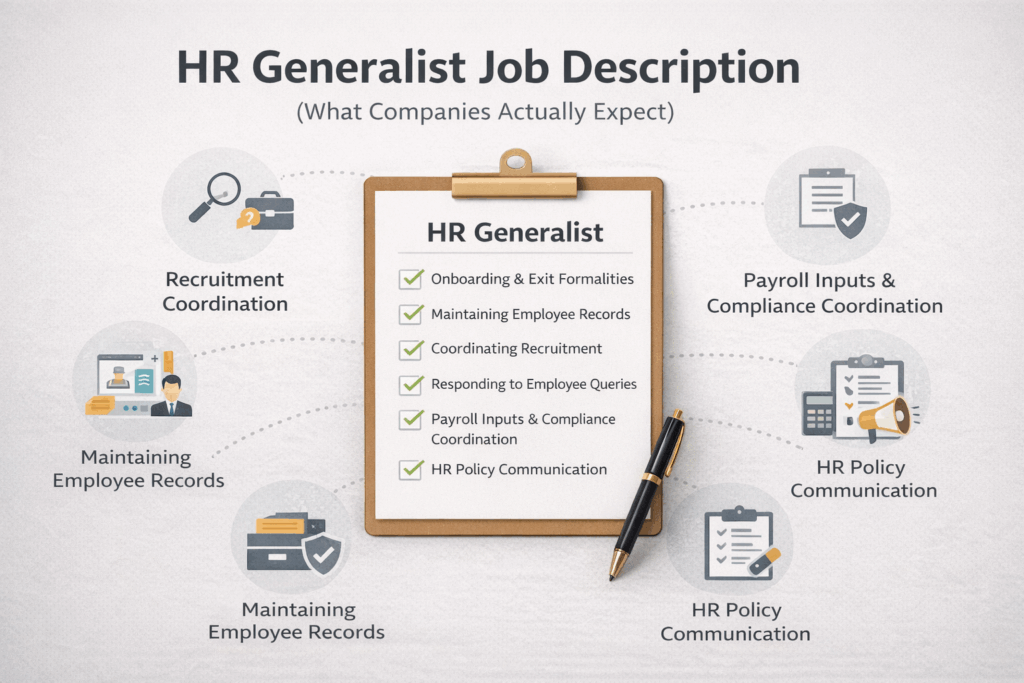
Most HR generalist job descriptions look broad—and that’s intentional.
Companies hire generalists because they need someone who can handle ambiguity, juggle priorities, and keep people processes running without constant supervision.
Common responsibilities you’ll see
- Managing onboarding and exit formalities
- Maintaining employee records and HRIS data
- Coordinating recruitment interviews and feedback
- Responding to employee HR queries
- Sharing payroll inputs with finance or payroll vendors
- Supporting performance appraisal cycles
- Helping with HR policies and internal communication
- Assisting in audits, documentation, and compliance coordination
Reporting structure
In most organizations, HR generalists report to:
- An HR Manager or HR Lead
- In startups, sometimes directly to founders or operations heads
As the organization grows, this role often becomes the foundation for HR Ops Lead or HRBP positions.
HR Generalist Roles & Responsibilities
If you’re wondering what is the role of an HR generalist, here’s the honest answer:
An HR generalist makes sure employees experience HR as organised, fair, and responsive—every single day.
Let’s break that down.
Recruitment support
Most HR generalists don’t “own” a hiring strategy—but they keep hiring moving.
- Interview scheduling
- Candidate communication
- Feedback follow-ups
- Offer rollout and joining coordination
Onboarding & employee lifecycle
This is where HR generalists spend a lot of time.
- Joining documentation
- Induction coordination
- Confirmation letters
- Internal transfers and promotions
- Exit formalities and exit interviews
When onboarding is smooth, employees trust HR. When it isn’t, everything else suffers.
Payroll and attendance coordination
In many Indian companies, payroll is handled by finance or an external vendor—but HR generalists:
- Validate attendance and leave
- Share payroll inputs
- Flag discrepancies
- Answer employee salary-related questions
Accuracy here matters. A single mistake can damage credibility.
Compliance coordination (India context)
Depending on the organization, HR generalists may support documentation related to:
- PF, ESIC, Professional Tax
- Shops & Establishment records
- Internal audits
This doesn’t mean legal decision-making, but it does mean process discipline.
Employee relations
This is the emotionally demanding part of the role.
- Listening to employee concerns
- Handling conflicts sensitively
- Documenting issues properly
- Escalating when needed
Good HR generalists don’t take sides—they take responsibility.
Performance & training support
- Appraisal timelines and documentation
- Training nominations and feedback tracking
- Coordination between managers and employees
Common KPIs HR generalists are judged on
- Time-to-fill (supporting hiring)
- Payroll accuracy
- HR ticket closure time
- Early attrition
- Onboarding completion rate
- Documentation compliance
HR Generalist Salary in India
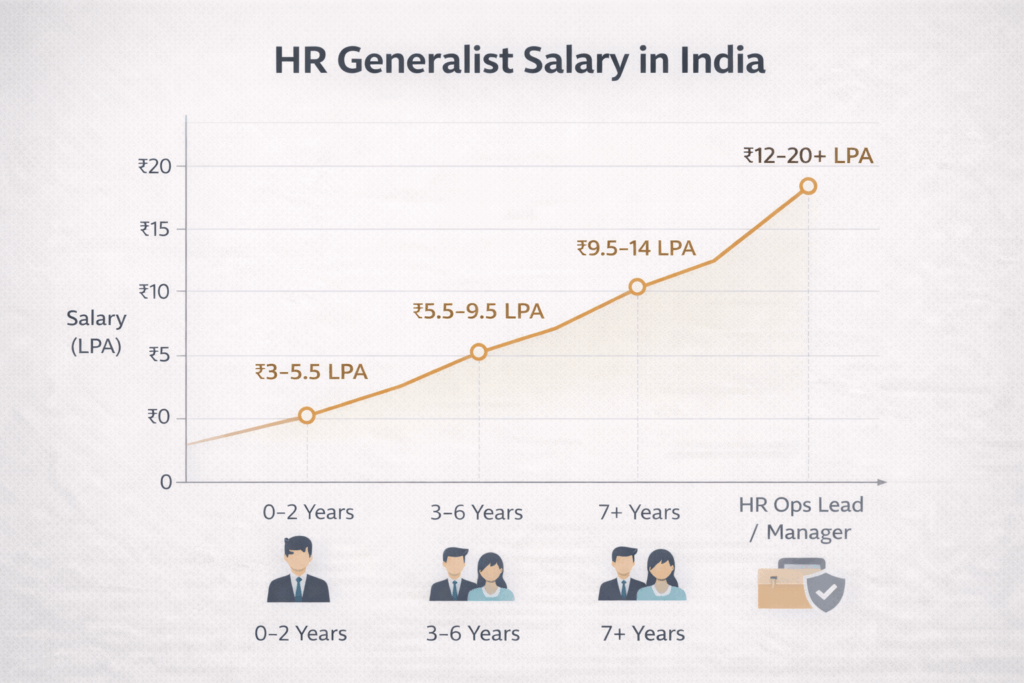
There is no single “correct” salary for an HR generalist in India. Pay depends heavily on city, industry, and scope of responsibility.
Average salary range (India)
Most market data places the average HR generalist salary around ₹5–6 LPA, with wide variation.
Salary by experience
| Experience | Salary Range (INR) |
| 0–2 years | ₹3 – ₹5.5 LPA |
| 3–6 years | ₹5.5 – ₹9.5 LPA |
| 7+ years | ₹9.5 – ₹14 LPA |
| HR Ops Lead / Manager | ₹12 – ₹20+ LPA |
Metro cities like Bengaluru, Gurgaon, Mumbai, and Hyderabad usually offer higher pay.
What increases HR generalist pay fastest
- Strong HRIS ownership
- Employee relations exposure
- Multi-location or plant HR experience
- Reporting and analytics capability
- Clear process improvements with results
HR Generalist Resume Guide (Resume & CV Examples)
Most HR resumes fail for one reason:
They list tasks, not impact.
A good HR generalist resume shows how your work improved outcomes.
Ideal resume structure
- Header (contact + LinkedIn)
- Short professional summary
- Key skills
- Experience (reverse chronological)
- Education & certifications
- Tools & systems
Strong resume bullet examples
- Reduced onboarding turnaround time by 40% through SOP standardisation
- Managed HR operations for 300+ employees across departments
- Achieved 99% payroll accuracy for two consecutive quarters
- Closed 95% of HR tickets within SLA
- Improved offer-to-join ratio through structured follow-ups
CV profile samples
Entry-level HR Generalist
HR Generalist with hands-on experience in onboarding, HR documentation, interview coordination, and HR MIS reporting. Comfortable with HRIS and Excel. Known for accuracy, responsiveness, and clear communication.
Mid-level HR Generalist
HR Generalist with 4+ years of experience in HR operations, payroll coordination, employee relations support, and performance cycles. Strong at process improvement and stakeholder management.
Senior HR Generalist
Senior HR Generalist with 8+ years of experience managing HR operations, ER cases, compliance coordination, and HR reporting across multi-location teams.
Resume formatting tips
- Keep it clean and readable
- Avoid tables and heavy design
- Use metrics wherever possible
- Save as PDF unless otherwise asked
Key HR Generalist Skills
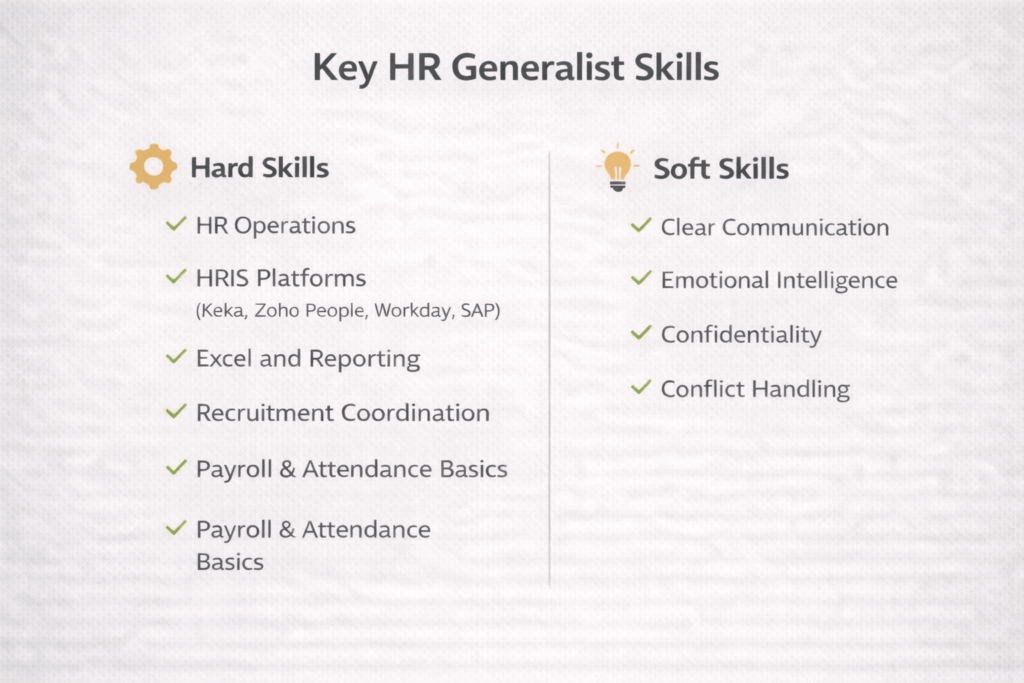
Hard skills
- HR operations
- HRIS platforms
- Excel and reporting
- Recruitment coordination
- Payroll and attendance basics
Soft skills
- Clear communication
- Emotional intelligence
- Confidentiality
- Conflict handling
- Time management
Common HR Generalist Interview Questions
- What is the role of an HR generalist?
- How do you handle employee grievances?
- Describe your onboarding process.
- How do you ensure payroll accuracy?
- What HR metrics do you track?
- How do you manage confidential information?
Tip: Speak from experience. Interviewers can tell when answers are memorised.
Career Growth After HR Generalist
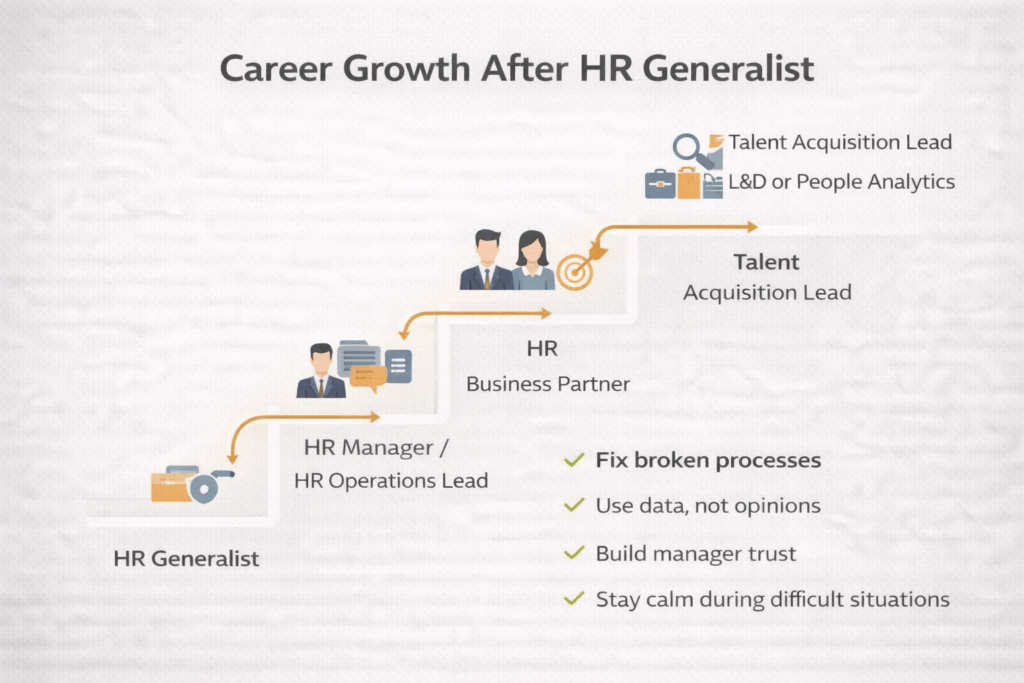
Most HR leaders start here.
From HR generalist roles, people typically move into:
- HR Manager / HR Operations Lead
- HR Business Partner
- Talent Acquisition Lead
- L&D or People Analytics roles
Growth comes faster when you:
- Fix broken processes
- Use data, not opinions
- Build manager trust
- Stay calm during difficult situations
Final Takeaway
The HR generalist role isn’t flashy—but it’s foundational.
If you want to understand how organizations really work, how people’s decisions get made, and how culture is built (or broken), this role will teach you more than any textbook ever could.
AIInterview helps HR generalists move from manual work to measurable impact.
From automating interview workflows and candidate evaluation to enabling structured, data-driven hiring decisions, AIInterview supports HR teams in building faster, fairer, and more scalable people processes.
If you’re an HR generalist—or building an HR function—AIInterview gives you the automation and insights needed to focus less on coordination and more on outcomes.
👉 Explore AIInterview and see how HR automation software can simplify hiring and strengthen decision-making.