Table of Contents
Introduction
Growth doesn’t happen by chance — it happens by planning your people.
Many organisations hire reactively, train inconsistently, and struggle with attrition simply because they lack a clear hr strategy. Without structure, HR becomes administrative instead of strategic, and business goals suffer.
An effective hr strategy aligns hiring, development, performance, and workforce planning with overall business objectives. It ensures you have the right people, with the right skills, at the right time.
In this guide, you’ll understand the hr strategy meaning, types of hr strategies, practical examples, and how hr strategy and hr planning work together to help you build a stronger, future-ready organisation.
What is HR strategy?
HR strategy is a structured plan that defines how people, skills, processes and culture will support business goals.
In simple terms:
Business strategy says “where we want to go.”
HR strategy says “who will take us there and how.”
Without it, organisations react. With it, they prepare.
When an HR strategy is in place, companies typically see:
- faster and better hiring decisions
- lower attrition
- stronger leadership pipelines
- improved productivity
- better workforce cost control
- clearer accountability
If you want predictable growth, you cannot treat HR as administration. It must function as a business partner.
Types of HR strategies
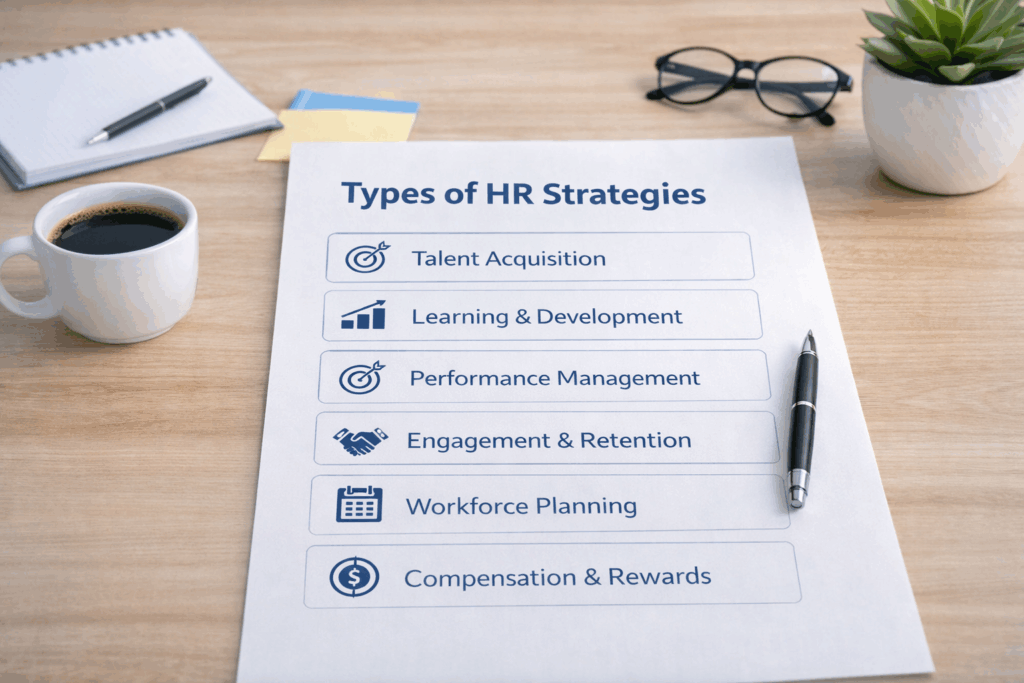
An effective HR strategy is not one single plan. It is a combination of focused approaches that address different people’s challenges within an organisation. Depending on your growth stage, industry, and business goals, you may adopt one or more types of HR strategies together.
Below are the most practical and commonly used types of HR strategies, explained in simple terms with clear use cases and outcomes.
1. Talent Acquisition Strategy
This strategy focuses on how you attract, assess, and hire the right talent quickly and cost-effectively. Instead of hiring reactively whenever a vacancy appears, organisations create a structured hiring pipeline aligned with future business needs.
It ensures that the right skills are available at the right time without delays or overspending.
Key actions include:
- workforce forecasting
- structured job descriptions
- competency-based interviews
- campus or lateral hiring plans
- technology or AI-based screening
Best used when:
- The company is scaling fast
- New teams or branches are opening
- Specialised skills are required
Outcome you can expect:
- faster hiring
- better candidate quality
- reduced hiring costs
- improved manager satisfaction
2. Learning and Development Strategy
This strategy focuses on building skills internally rather than constantly hiring externally. It helps employees grow with the organisation and prepares them for future roles.
It is especially useful when markets or technology are changing quickly.
Key actions include:
- skill gap analysis
- training calendars
- certification programmes
- leadership development
- mentoring and coaching
Best used when:
- Digital transformation is happening
- New tools or systems are introduced
- Internal promotions are preferred
Outcome you can expect:
- Higher employee capability
- lower hiring costs
- stronger internal leadership pipeline
- better retention
3. Performance Management Strategy
This strategy ensures every employee’s work directly contributes to business goals. It replaces annual reviews with continuous goal-setting and feedback.
Without a performance strategy, employees often work hard but not necessarily on the right priorities.
Key actions include:
- clear KPIs or OKRs
- quarterly reviews
- feedback systems
- performance-linked rewards
- manager coaching
Best used when:
- Productivity is low
- Accountability is unclear
- Teams miss targets
Outcome you can expect:
- improved productivity
- clear ownership
- higher goal alignment
- better business results
4. Engagement and Retention Strategy
This strategy focuses on keeping employees motivated, satisfied, and loyal. Hiring new employees is expensive, so retaining existing talent becomes critical.
It addresses workplace culture, recognition, well-being, and growth opportunities.
Key actions include:
- recognition programmes
- career path clarity
- flexible work options
- employee surveys
- wellbeing initiatives
Best used when:
- Attrition is high
- Morale is low
- Burnout is common
Outcome you can expect:
- reduced turnover
- stronger culture
- higher engagement
- lower replacement costs
5. Workforce Planning Strategy
This strategy helps organisations forecast future manpower needs and manage costs efficiently. It prevents both overstaffing and understaffing.
It is a data-driven approach that connects hiring plans with revenue targets and budgets.
Key actions include:
- headcount forecasting
- succession planning
- demand-supply analysis
- budgeting for manpower
- seasonal or project-based hiring
Best used when:
- Budgets are tight
- growth needs careful control
- large or distributed teams exist
Outcome you can expect:
- optimised staffing costs
- better capacity planning
- fewer last-minute hires
- smoother operations
6. Compensation and Rewards Strategy
This strategy focuses on designing fair and competitive pay structures that attract and retain talent while keeping costs under control.
Compensation is not just salary — it includes incentives, benefits, and recognition.
Key actions include:
- salary benchmarking
- performance incentives
- bonuses
- benefits packages
- rewards programmes
Best used when:
- Hiring is difficult
- competitors offer better pay
- Employees leave for salary reasons
Outcome you can expect:
- improved hiring success
- higher retention
- stronger motivation
7. Culture and Employer Branding Strategy
This strategy builds how employees and candidates perceive your organisation. A strong brand attracts talent naturally and improves engagement internally.
Today, culture plays a major role in career decisions.
Key actions include:
- defining core values
- internal communication
- social presence
- employee testimonials
- inclusive practices
Best used when:
- Attracting top talent is difficult
- Employee satisfaction is inconsistent
- company’s reputation needs strengthening
Outcome you can expect:
- better candidate quality
- higher engagement
- positive workplace culture
- stronger brand image
How to choose the right mix
Most organisations don’t pick only one strategy. Instead, they combine 3–4 depending on priorities.
For example:
- Startup → talent acquisition + workforce planning
- Mid-size tech → performance + learning + retention
- Large enterprise → planning + engagement + compensation
The key is alignment with business goals, not copying others.
HR strategy and HR planning – how they connect
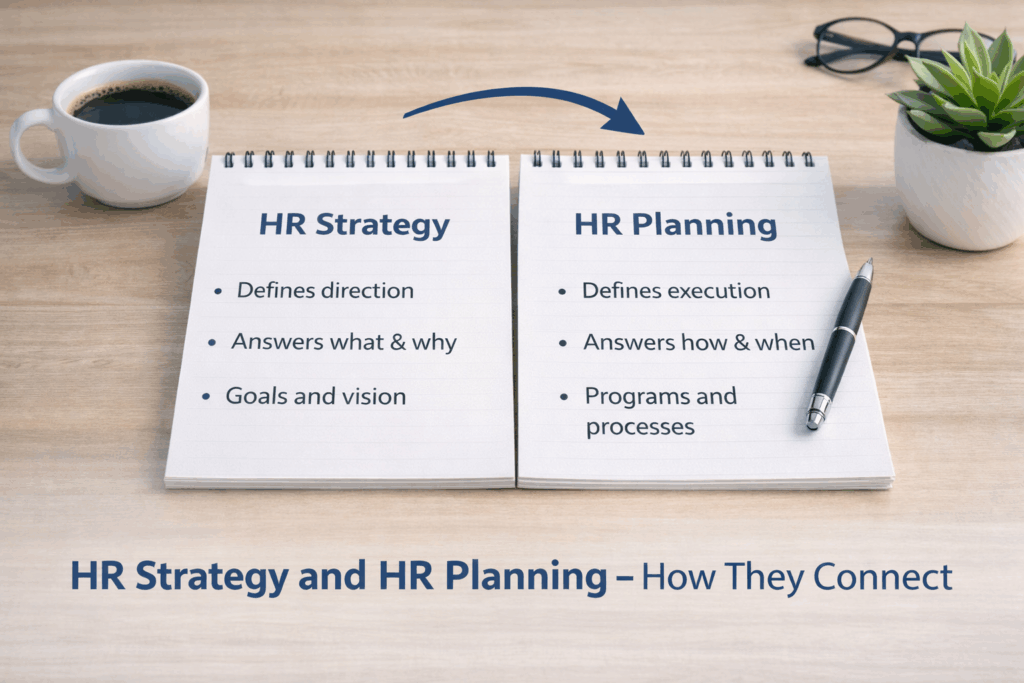
Many leaders confuse these two terms, but they serve different purposes.
HR strategy defines direction.
HR planning defines execution.
Think of it like this:
- Strategy = what & why
- Planning = how & when
If strategy is missing, planning becomes guesswork.
If planning is missing, strategy remains on paper.
Simple 6-step alignment process
Follow this sequence:
- Define business goals
- Identify skill gaps
- Forecast manpower
- Design hiring & training plans
- Allocate budgets
- Track outcomes quarterly
This alignment prevents last-minute hiring, overspending and skill shortages.
Building an Effective HR Strategy – A Practical Step-by-Step Approach
Creating an effective HR strategy is not about writing a long policy document or copying frameworks from large corporations. It’s about making clear, practical decisions that directly support your business goals.
Many organisations overcomplicate this process. In reality, a good HR strategy is built step by step — starting with clarity, followed by planning, execution, and measurement.
Below is a simple, actionable approach you can realistically implement within 60–90 days, even with a small HR team.
Step 1: Start with business clarity, not HR activities
Before discussing hiring, training, or policies, first understand what the business is trying to achieve. HR exists to enable business success, not run isolated programmes.
Sit with leadership and ask direct questions:
- What are our growth targets this year?
- Are we expanding into new markets?
- Are we launching new products or services?
- Are we planning automation or digital transformation?
- Where are we losing money or efficiency today?
When business goals are unclear, HR becomes reactive. When goals are clear, HR becomes strategic.
Outcome of this step:
- 12–18 month business priorities documented
- Hiring and capability expectations defined
Step 2: Audit your current workforce reality
Once direction is clear, evaluate your present situation honestly. Many HR plans fail because decisions are based on assumptions rather than data.
Analyse:
- total headcount
- critical roles
- existing skills
- performance levels
- attrition trends
- hiring delays
- salary costs
Create a simple skills matrix or workforce dashboard. This will show where strengths and gaps exist.
For example, you may discover:
- Too many junior employees, but few leaders
- high attrition in sales
- skill gaps in technology
Outcome of this step:
- clear picture of “where we are today”
Step 3: Identify workforce gaps and future needs
Now compare business goals with your workforce reality. The gap between these two is your real HR challenge.
Ask:
- What skills will we need in the next 12 months?
- Which roles are critical for growth?
- Can we train internally or must we hire externally?
- How many people do we actually need?
Convert these into numbers:
- headcount forecast
- skill requirements
- timeline
This prevents last-minute hiring and budget shocks.
Outcome of this step:
- manpower plan with numbers and timelines
Step 4: Choose the right HR strategy mix
At this stage, decide which types of HR strategies you actually need. Not every company needs everything.
For example:
- rapid growth → talent acquisition strategy
- high attrition → retention strategy
- low productivity → performance strategy
- skill shortages → learning strategy
Prioritise 2–3 focus areas instead of trying to fix everything at once.
Trying to do too much leads to zero impact.
Outcome of this step:
- clear priority areas for the year
Step 5: Design specific initiatives (not vague ideas)
Avoid writing broad goals like “improve engagement” or “hire better people.” These are not actionable.
Instead, define specific initiatives.
For example:
Instead of: Improve hiring
Define:
- structured interviews for all roles
- hiring scorecards
- Reduce time-to-hire to 30 days
Instead of: Improve retention
Define:
- quarterly manager check-ins
- career path framework
- recognition programme
Break each initiative into:
- owner
- timeline
- budget
- success metric
Outcome of this step:
- clear execution roadmap
Step 6: Allocate budgets and tools
No strategy works without resources. Many HR plans fail because they depend only on manual effort.
Decide early:
- hiring tools
- interview platforms
- learning systems
- analytics dashboards
- external consultants if needed
Investing in the right tools saves time and reduces errors.
For example, structured digital interviews can cut screening time by 40–50%.
Outcome of this step:
- approved budget and technology stack
Step 7: Communicate and align managers
A common mistake is keeping HR strategy inside the HR department. Managers are the real executors.
If they don’t understand the plan, nothing changes.
Communicate clearly:
- What is changing
- Why it matters
- What must I do?
- How success will be measured
Use townhalls, training sessions, and simple guides.
When managers buy in, adoption becomes easy.
Outcome of this step:
- organisation-wide alignment
Step 8: Implement in phases, not all at once
Rolling out everything together creates chaos. Instead, phase your initiatives.
Example timeline:
- Quarter 1 → hiring process improvement
- Quarter 2 → performance management system
- Quarter 3 → learning programmes
- Quarter 4 → engagement initiatives
Phased execution allows smoother adoption and easier corrections.
Outcome of this step:
- manageable implementation
Step 9: Measure what matters
If you don’t measure results, you won’t know whether the strategy is working.
Track a few key metrics consistently:
- time-to-hire
- cost-per-hire
- attrition rate
- employee engagement score
- training completion
- productivity per employee
Review these quarterly. If numbers aren’t improving, refine your approach.
Strategy is not static — it evolves.
Outcome of this step:
- continuous improvement cycle
Step 10: Review and refine annually
Business priorities change. Markets change. Skills change.
So your HR strategy should also evolve.
Conduct an annual review:
- what worked
- What didn’t
- What to stop
- What to scale
This keeps your people strategy relevant and future-ready.
Outcome of this step:
- updated, stronger HR strategy every year
Quick recap – practical checklist
Here’s a simple summary you can use immediately:
- clarify business goals
- assess current workforce
- identify gaps
- Prioritise strategy areas
- design specific initiatives
- allocate budgets and tools
- align managers
- Implement in phases
- track KPIs
- review annually
If you follow this process consistently, HR moves from reactive problem-solving to proactive business growth.
Tools, metrics and KPIs to measure HR strategy success
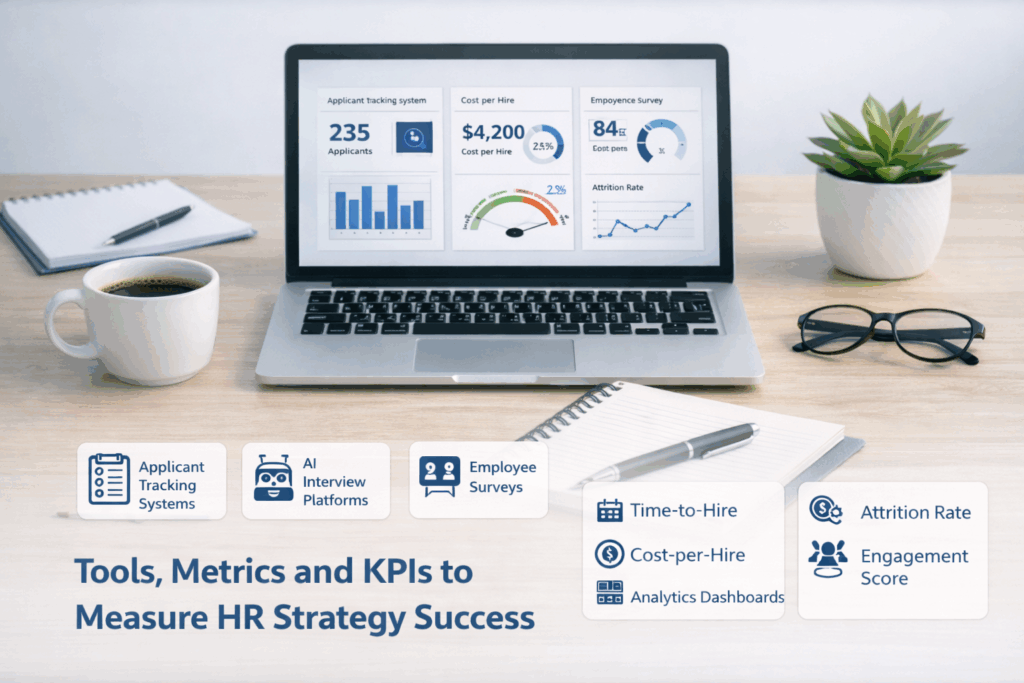
Technology makes execution easier.
Useful tools include:
- applicant tracking systems
- AI interview platforms
- learning systems
- employee surveys
- analytics dashboards
Key metrics to track:
- time-to-hire
- cost-per-hire
- attrition rate
- engagement score
- training completion
- Revenue per employee
If numbers don’t improve, the strategy needs refinement.
Conclusion
A strong hr strategy transforms HR from a support function into a growth engine.
Instead of reacting to problems, you anticipate them.
Instead of random hiring, you hire with clarity.
Instead of high attrition, you build loyalty.
The difference is not budget or size.
The difference is planning.
If you want your workforce to drive measurable business outcomes, now is the time to formalise your approach.
Ready to build a smarter HR strategy and hire better talent faster?
Get AI-powered interview solutions at AIInterview.in.
Book your free demo today.
FAQs
What is HR strategy in simple words?
It is a plan that aligns people practices with business goals.
Why is HR strategy important?
It improves hiring, retention, productivity and cost control.
How is HR strategy different from HR planning?
Strategy defines direction; planning defines execution steps.
How often should HR strategy be reviewed?
At least annually or during major business changes.
Can small businesses use an HR strategy?
Yes. Even small teams benefit from structured planning.
What are the key metrics to track?
Time-to-hire, attrition, engagement and productivity.