Table of Contents
- 1. What is an Employee Management System?
- 2. Why Employee Management Matters for Indian Businesses Today
- 3. Deep Dive: Core Modules of an Employee Management System
- 4. How to Choose the Right Employee Management System
- 5. Implementation Roadmap & Best Practices
- 6. Common Pitfalls (and How to Avoid Them)
- 7. On-Premise vs Cloud vs Hybrid EMS
- Final Recommendation
- Strong CTA
- FAQs (Snippet-Optimised)
Payroll errors. Attendance confusion. Leave disputes. Training that never scales.
If you manage people at scale—even 20 employees—you’ve felt this chaos.
Indian HR teams today are expected to do more with less: stay compliant, support hybrid work, reduce costs, and still keep employees engaged. That’s exactly where a modern employee management system earns its keep.
This guide breaks it all down—attendance, payroll, leave, learning, and records—with a practical, India-first lens.
1. What is an Employee Management System?
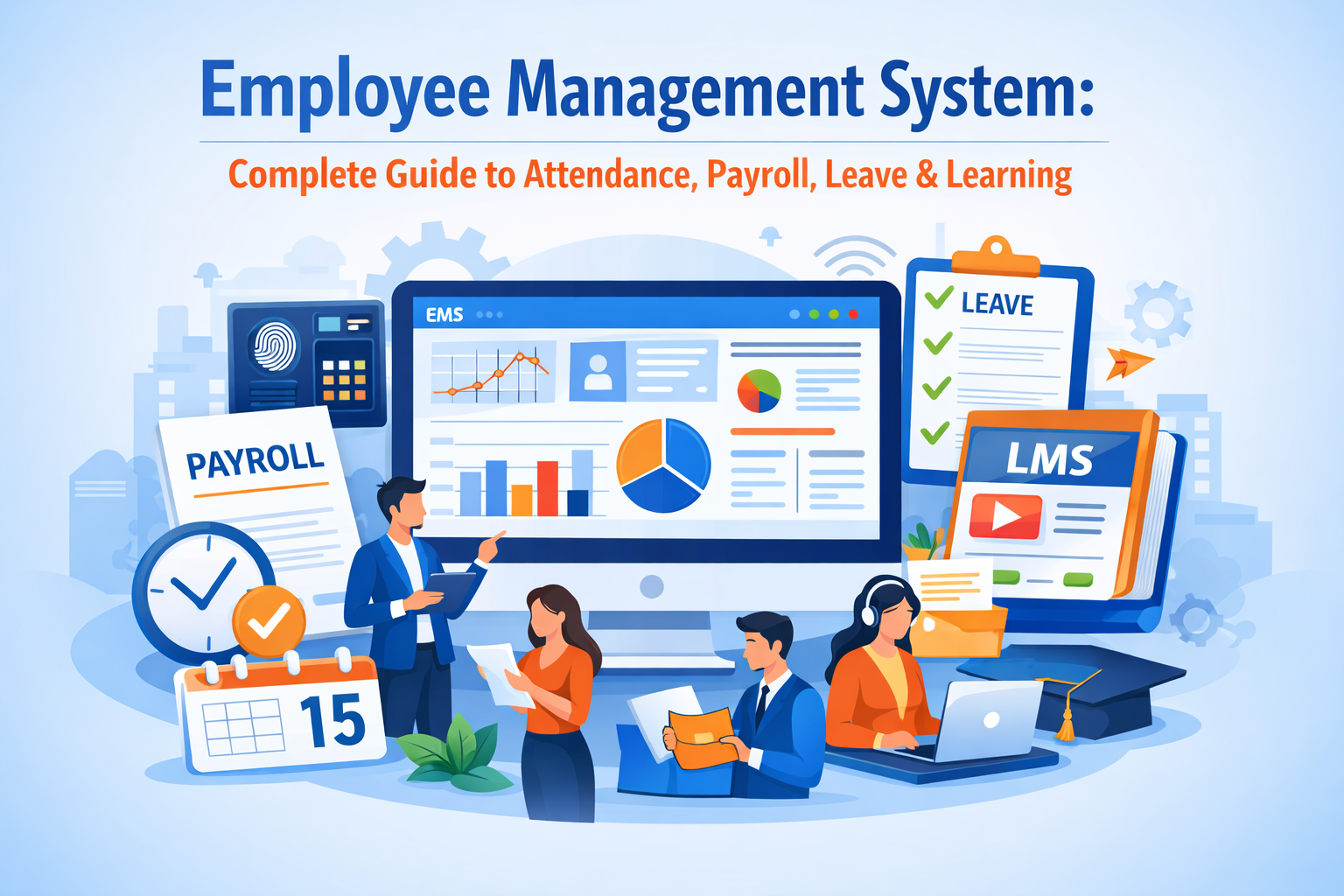
An employee management system (EMS) is a unified HR software platform that helps organisations manage the entire employee lifecycle—from onboarding and attendance to payroll, learning, and compliance.
Think of it as the operating system for your workforce.
Core Modules of an EMS
- Employee attendance management system
- Employee payroll management system
- Employee leave management system
- Employee learning management system (LMS)
- Employee record management system
Most modern EMS platforms fall under the broader category of HRMS (Human Resource Management System).
2. Why Employee Management Matters for Indian Businesses Today
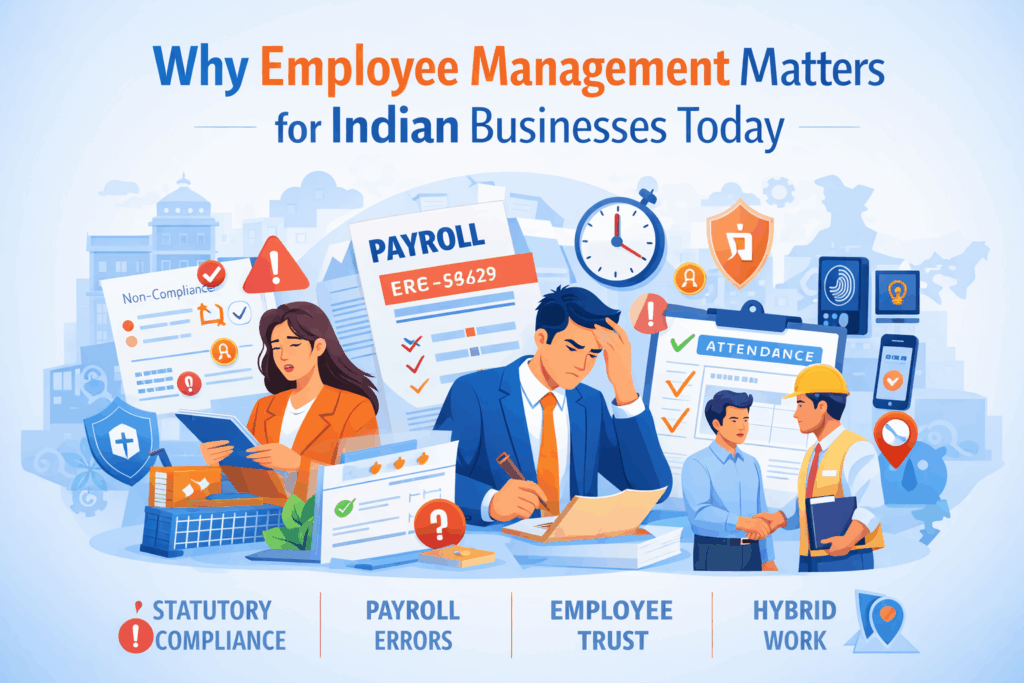
Employee management is no longer just an HR function—it’s a business-critical system. In today’s Indian business environment, companies that fail to modernise how they manage people pay the price in lost productivity, compliance risks, and poor employee experience.
Here’s why a strong employee management system matters more than ever.
1. India’s Compliance Landscape Is Unforgiving
Indian labour laws are detailed, evolving, and strictly enforced. Even a small error in payroll or statutory filings can lead to penalties, audits, or legal exposure.
An effective employee management system helps businesses:
- Automate PF, ESI, professional tax, gratuity, and TDS
- Maintain accurate attendance and wage records
- Generate audit-ready reports on demand
- Stay aligned with state-specific labour laws
Manual processes don’t scale—and spreadsheets don’t protect you during audits.
2. Hybrid & Remote Work Have Changed Attendance Forever
The traditional “biometric at office gate” model no longer fits modern workplaces.
Indian businesses now manage:
- Remote teams across cities and states
- Hybrid schedules and flexible shifts
- Field staff and sales teams on the move
A modern employee attendance management system supports:
- Mobile and GPS-based attendance
- Shift and roster flexibility
- Accurate overtime and work-hour tracking
Without this, HR teams struggle to balance trust, transparency, and control.
3. Payroll Errors Directly Damage Employee Trust
In India, salary accuracy is not optional—it’s emotional.
Late salaries, wrong deductions, or missing payslips quickly erode trust. A reliable employee payroll management system ensures:
- Error-free salary processing
- On-time payslips and bank transfers
- Clear visibility into deductions and benefits
When payroll runs smoothly, employee confidence in the organisation increases automatically.
4. Growing Teams Need Structure, Not Heroics
Many Indian SMEs rely on a few “go-to” HR or admin staff who hold everything together manually. This works—until it doesn’t.
As headcount grows:
- Leave tracking becomes chaotic
- Records get scattered across emails and folders
- HR teams burn out handling repetitive tasks
A structured employee record management system creates a single source of truth and removes dependency on individuals.
5. Learning & Upskilling Are Now Business Priorities
India’s talent market is fast-moving. Skills become outdated quickly, and attrition is expensive.
An integrated employee learning management system allows companies to:
- Standardise onboarding
- Deliver role-based training
- Track certifications and compliance learning
- Prepare employees for future roles
Training is no longer a “nice-to-have”—it’s a retention and performance lever.
6. Cost Control Without Micromanagement
Indian businesses are under constant pressure to control costs while still growing.
Employee management systems help by:
- Reducing payroll processing time
- Cutting compliance penalties
- Improving workforce utilisation
- Providing data for better decisions
This isn’t micromanagement—it’s operational clarity.
Key Drivers
1. Statutory Compliance Pressure
PF, ESI, professional tax, labour laws, Shops & Establishments Acts—non-compliance isn’t optional anymore.
2. Hybrid & Remote Work
Biometric-only attendance no longer works. HR needs mobile, geo-tagged, flexible systems.
3. Cost & Productivity Control
Manual payroll errors cost time, trust, and penalties.
4. Talent Retention
Employees expect transparency: payslips, leave balances, learning paths—self-service is no longer a “nice to have”.
3. Deep Dive: Core Modules of an Employee Management System
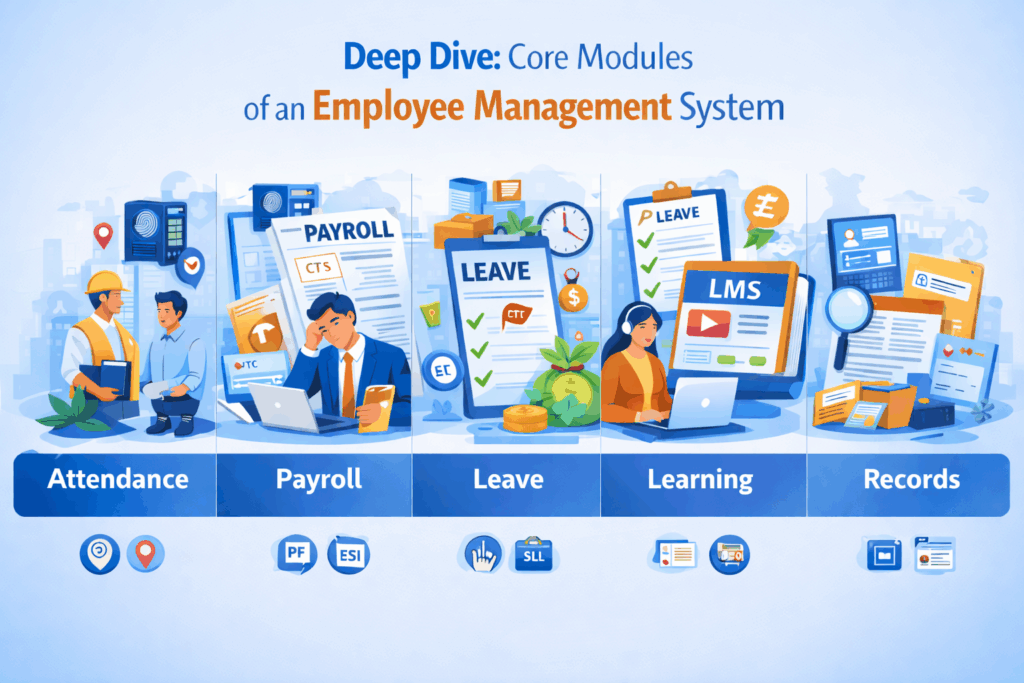
A modern employee management system is not a single tool—it’s a tightly integrated set of modules that work together to manage people operations end to end. When these modules operate in silos, HR chaos follows. When they’re integrated, efficiency compounds.
Let’s break down the core modules every serious employee management platform must include.
A. Employee Attendance Management System
What it does
Tracks employee working hours, shifts, overtime, late arrivals, and absences.
Key Features to Look For
- Biometric integration (fingerprint, face)
- Mobile & GPS-based attendance
- Shift & roster management
- Overtime and late-coming rules
- Integration with payroll
India-Specific Considerations
- Factory Act & Shops Act hour limits
- Night shift rules (especially for women employees)
- Multi-location attendance policies
Business Benefits
- Reduces attendance disputes
- Automates salary calculations
- Improves workforce visibility
B. Employee Payroll Management System
What it does
Automates salary calculation, deductions, statutory compliance, and payslip generation.
Key Features
- PF, ESI, PT, TDS automation
- Salary structures (CTC, gross, net)
- Bonus, arrears, reimbursements
- Bank transfer integration
- Year-end Form 16 support
India-Specific Compliance
- Provident Fund (EPFO)
- Employee State Insurance (ESI)
- Professional Tax (state-wise)
- Gratuity calculations
Business Benefits
- Payroll cycle reduced from days to hours
- Fewer compliance penalties
- Accurate, auditable salary records
C. Employee Leave Management System
What it does
Manages leave policies, approvals, balances, and statutory compliance.
Key Features
- Custom leave types (CL, SL, EL, maternity, paternity)
- Accrual & carry-forward rules
- Approval workflows
- Holiday calendars (state-wise)
- Leave encashment
India-Specific Rules
- State-specific statutory leaves
- Maternity Benefit Act compliance
- Encashment during exit
Business Benefits
- Eliminates leave conflicts
- Transparent policies
- Better employee satisfaction
D. Employee Learning Management System (LMS)
What it does
Delivers, tracks, and measures employee training and skill development.
Key Features
- Role-based learning paths
- Onboarding training modules
- Certifications & assessments
- Progress tracking
- Integration with performance reviews
Why LMS Matters in India
- Upskilling for fast-changing roles
- Compliance training (POSH, safety)
- Reduced training costs
A modern employee learning management system improves retention and readiness.
E. Employee Record Management System
What it does
Maintains a secure, central repository of employee data.
Key Records Managed
- Personal details
- Offer letters & contracts
- KYC documents
- Performance history
- Exit records
Key Benefits
- Single source of truth
- Faster audits
- Secure access controls
4. How to Choose the Right Employee Management System
Evaluation Checklist
Business Fit
- Employee count today & 3-year growth
- Industry-specific needs
Technology
- Cloud vs on-premise
- Mobile accessibility
- Integration with existing tools
Compliance
- India-specific statutory support
- Regular compliance updates
Usability
- HR ease-of-use
- Employee self-service
Support
- Local support team
- Implementation assistance
5. Implementation Roadmap & Best Practices
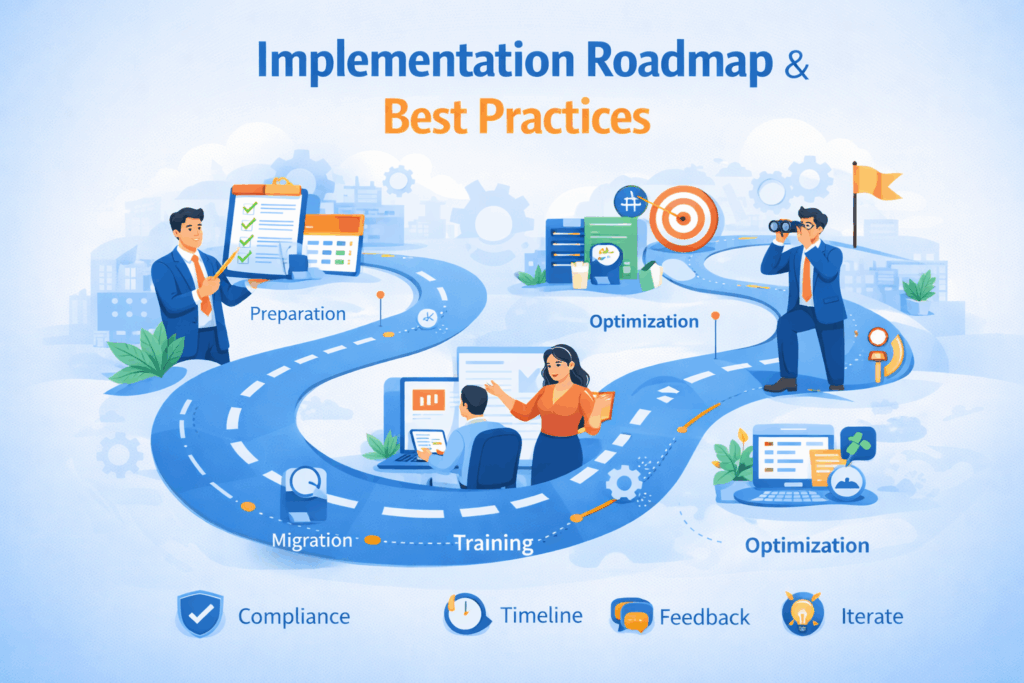
Step 1: Start with a Pilot
Roll out to one department or location.
Step 2: Clean Data Migration
Fix employee records before importing.
Step 3: HR & Manager Training
Adoption depends on confidence.
Step 4: Employee Onboarding
Explain “what’s in it for them”.
Step 5: Review & Optimise
Adjust policies after real usage.
6. Common Pitfalls (and How to Avoid Them)
| Mistake | How to Avoid |
| Buying only for payroll | Choose an integrated EMS |
| Ignoring mobile users | Ensure strong mobile UX |
| No change management | Communicate early |
| Weak integrations | Check APIs upfront |
| Over-customisation | Start simple |
7. On-Premise vs Cloud vs Hybrid EMS
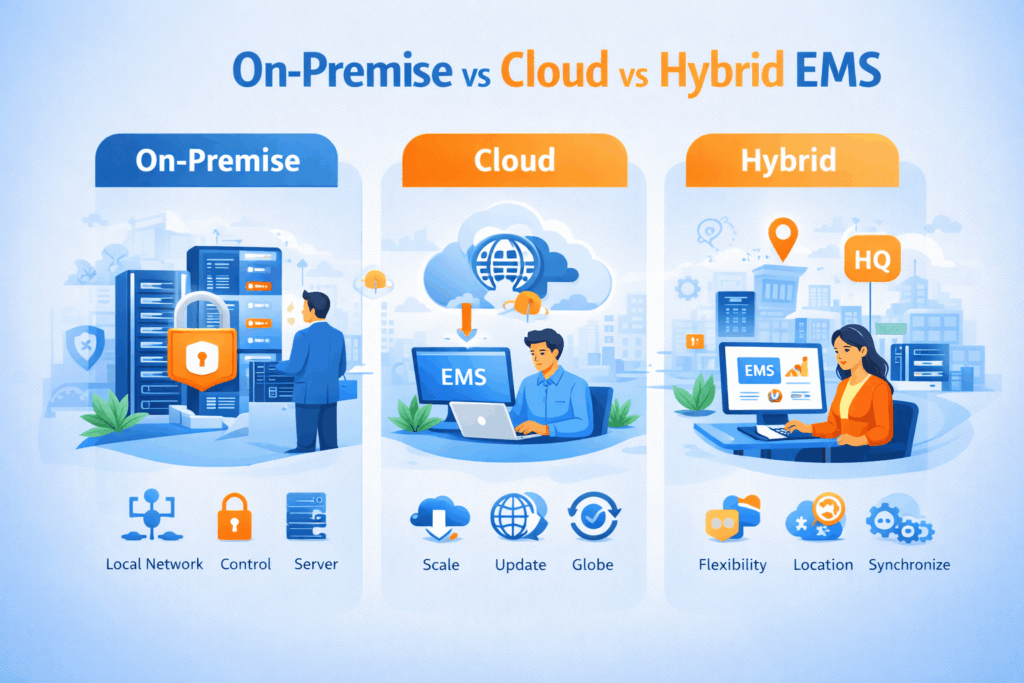
| Factor | On-Premise | Cloud | Hybrid |
| Cost | High upfront | Subscription | Medium |
| Scalability | Limited | Excellent | Good |
| Compliance updates | Manual | Automatic | Partial |
| Security | Internal control | Vendor-managed | Shared |
| Best for | Govt / legacy | SMEs & startups | Regulated firms |
Final Recommendation
If you’re still managing HR on spreadsheets, you’re not just wasting time—you’re risking compliance and employee trust.
A modern employee management system isn’t a cost.
It’s a control system for growth.
👉 If you’re already using AI to hire smarter with ai recruiting tool, your people operations should be just as intelligent.
Strong CTA
Ready to modernise your HR stack?
👉 Book a demo and see how intelligent HR systems simplify people management end-to-end.
FAQs (Snippet-Optimised)
1. What is an employee management system?
An employee management system is HR software that manages attendance, payroll, leave, learning, and employee records from a single platform.
2. Is an employee management system mandatory in India?
Not legally mandatory, but highly recommended to comply with PF, ESI, labour laws, and audit requirements.
3. What is the difference between HRMS and EMS?
EMS focuses on employee operations; HRMS is broader and may include recruitment, performance, and analytics.
4. Does EMS support PF and ESI calculations?
Yes, modern systems automate PF, ESI, professional tax, and statutory deductions.
5. Can attendance systems work without biometrics?
Yes. Mobile, GPS, and web-based attendance systems are common in hybrid workplaces.