Table of Contents
- 1. Communicate Clearly and Early
- 2. Make the Application Process Short and Simple
- 3. Use Structured Interviews (and AI Where Needed)
- 4. Set Clear Expectations Before the Interview
- 5. Train Interviewers to Interact Well
- 6. Give Feedback Quickly
- 7. Keep Candidates Warm Between Stages
- 8. Personalise the Experience
- 9. Strengthen Your Employer Brand
- 10. Make Onboarding Warm and Simple
- Short Micro Case Study
- 6 Important KPIs to Track Candidate Experience
- 4–6 Useful Tools for Better Hiring
- 10-Point Quick Checklist
- FAQs
Most companies don’t lose candidates because of salary or skill mismatch.
They lose them because the hiring experience feels slow, confusing, or impersonal.
A great improve candidate experience is now one of the biggest reasons people choose one employer over another. It affects your offer acceptance rate, employer brand, and even how many people apply to future openings.
Here are ten simple practices that make your hiring process smoother, more respectful, and far more candidate-friendly.
1. Communicate Clearly and Early
Candidates feel anxious when they don’t know what’s happening. A short message at the right time can completely change their impression of your company.
Tell them:
- that their application was received
- when they will hear back
- how many rounds to expect
- who the point of contact is
A simple confirmation email within a few minutes of applying can set a positive tone for the entire journey.
Quick things you can do
- Use a friendly acknowledgement email.
- Give a short timeline of the hiring stages.
- Reply within 24–48 hours whenever possible.
Success metric:
Watch your “candidate follow-up emails” count. Fewer follow-ups = clear communication.
2. Make the Application Process Short and Simple
Long forms push people away. SHRM reports that more than half of applicants drop off if the process takes too long.
Keep your application:
- mobile-friendly
- short (10–12 fields max)
- free from repeated data entry
If the candidate uploads a CV, don’t make them rewrite every detail manually.
Practical steps
- Enable “Apply with LinkedIn/Resume”.
- Avoid unnecessary questions.
- Use simple, clean design that loads quickly.
Success metric:
Track “application completion rate”. A big improvement here directly boosts your number of qualified candidates.
3. Use Structured Interviews (and AI Where Needed)
Structured interviews make the hiring process fair and predictable. Every candidate answers similar questions, and every interviewer uses the same scorecard.
This reduces bias and makes candidates feel respected.
How to structure interviews
- Prepare a clear question list.
- Use a scoring system for each question.
- Train interviewers to use the scorecard.
A simple example for “Tell me about yourself”:
- Relevance to role: 1–5
- Clarity: 1–5
- Experience depth: 1–5
Where AI helps
Platforms like AIInterview can run automated interviews, score responses, and reduce the need for multiple screening rounds. This makes the process much faster for candidates.
Internal link: https://aiinterview.in/
Success metric:
Scorecard usage rate. More completed scorecards = better consistency.
4. Set Clear Expectations Before the Interview
Candidates perform better when they know what’s coming. Never surprise them with unexpected tasks or new interviewers.
Share:
- duration of the interview
- type of round
- names of interviewers
- any preparation material
- meeting link or venue
This shows respect and helps candidates feel calm.
Success metric:
Monitor your “candidate no-show rate”. When expectations are clear, no-shows drop sharply.
5. Train Interviewers to Interact Well
Even a well-designed hiring process can feel unpleasant if the interviewer is cold, unprepared, or rude.
Train your panel to:
- welcome candidates warmly
- ask questions slowly and clearly
- avoid interruptions
- stay neutral and avoid bias
- thank candidates for their time
A small behaviour change here creates a huge impact.
Success metric:
Candidate rating for interview experience (short post-interview survey).
6. Give Feedback Quickly
Being ignored after an interview frustrates candidates the most. Even a simple one-line update is better than silence.
Share feedback within 2–5 working days.
Keep it honest but respectful.
Sample feedback message
“Thank you for interviewing with us. You communicated clearly and showed strong domain knowledge. At this time, we’re looking for someone with deeper experience in client handling. We wish you the best for future opportunities.”
Success metric:
Feedback turnaround time (days).
7. Keep Candidates Warm Between Stages
If your process takes longer, keep them informed.
A short update like “We’re still reviewing this round” goes a long way.
Warm messages prevent candidates from feeling forgotten — and prevent them from joining competitors during your delay.
Warm engagement ideas
- Weekly status updates
- Share your culture page
- Share a useful blog post (e.g., this one: Common hiring problem)
- Send a quick check-in call or WhatsApp message
Success metric:
Mid-process drop-off rate.
8. Personalise the Experience
Nobody likes feeling like “Applicant #52”. Use their name and refer to their experience.
Simple personalisation examples:
- “Your background in healthcare analytics stood out to us…”
- “We noticed you’ve handled customer escalations before…”
Give them one point of contact. This builds trust and comfort.
Success metric:
Offer acceptance rate — personalisation increases acceptance.
9. Strengthen Your Employer Brand
Candidates choose companies where they feel they will belong. Show them who you are.
Share:
- team photos
- short culture videos
- stories from current employees
- career growth examples
Referrals and repeat applicants increase when the brand feels human.
Success metric:
Career page views + application rate from that page.
10. Make Onboarding Warm and Simple
Candidate experience doesn’t end with the offer. Your onboarding decides their first impression as an employee.
Give them:
- a warm welcome email
- a small joining kit (digital or physical)
- details for day 1
- introduction to team members
- a buddy to help during the first week
This helps them feel included and confident from day one.
Success metric:
New hire retention at 30 and 90 days.
Short Micro Case Study
A mid-sized fintech company in Pune noticed that nearly 40% of candidates dropped off after the first interview. They changed only three things:
- clearer interview instructions,
- structured interviews, and
- weekly updates.
Within eight weeks, drop-offs reduced to 12% and offer acceptances went up by 20%.
A small shift in candidate experience transformed their hiring funnel.
6 Important KPIs to Track Candidate Experience
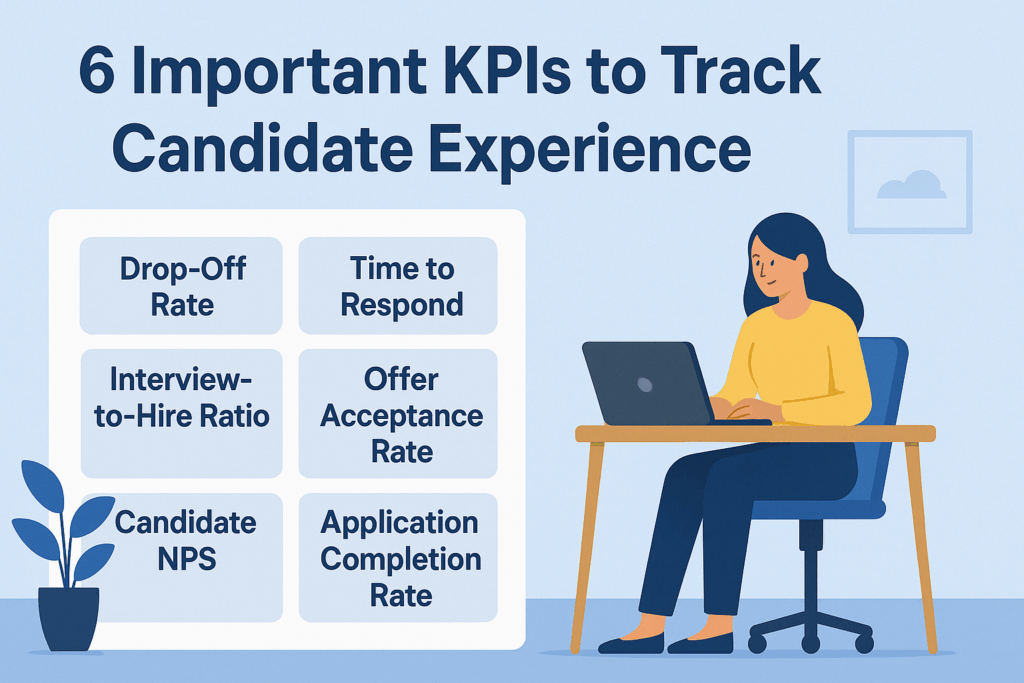
- Drop-Off Rate – Tracks where candidates leave the process.
- Time to Respond – Measures how fast you reply.
- Interview-to-Hire Ratio – Shows screening quality.
- Offer Acceptance Rate – Indicates trust and satisfaction.
- Candidate NPS – Simple “How was your experience?” rating.
- Application Completion Rate – Shows if your job form is too long.
4–6 Useful Tools for Better Hiring
- AIInterview – AI voice interviews for fast, fair, structured screening.
- Recruitee – Easy ATS and pipelines.
- LinkedIn Talent Insights – Talent data and market analysis.
- Google Workspace – Docs, forms, interview scorecards.
- HackerRank – Coding and technical assessments.
- Calendly – Fast scheduling without long email chains.
10-Point Quick Checklist
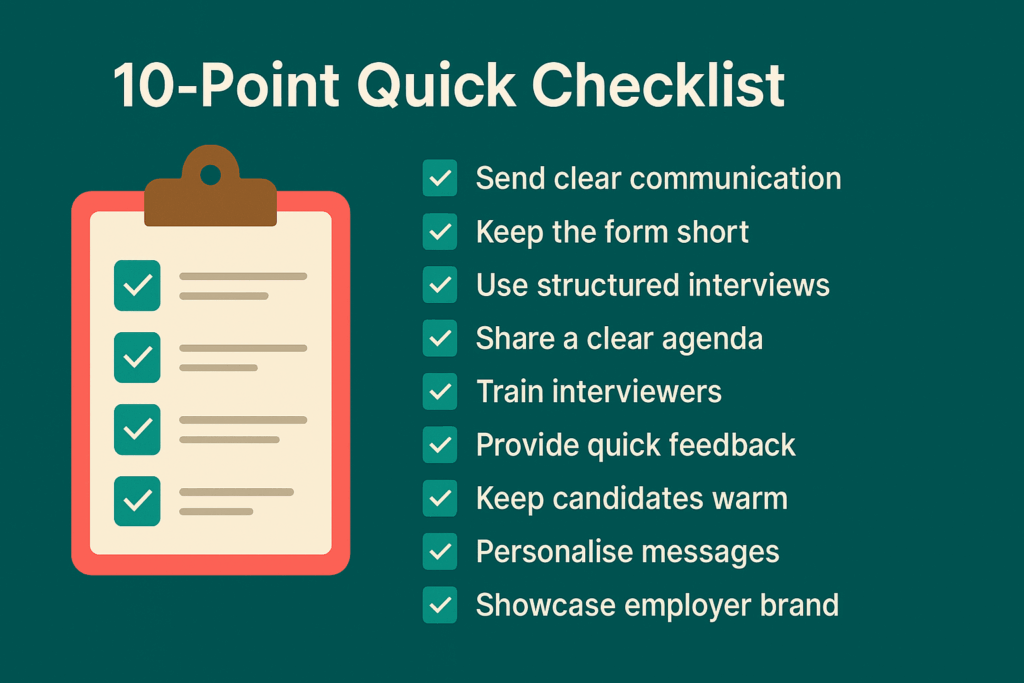
- Send clear communication
- Keep the form short
- Use structured interviews
- Share a clear agenda
- Train interviewers
- Provide quick feedback
- Keep candidates warm
- Personalise messages
- Showcase employer brand
- Make onboarding smooth
Email Templates
1. Interview Invitation
Subject: Interview for {{Role}} at {{Company}}
Hi {{Name}},
Thank you for applying. We’d love to speak with you for the {{Round}} round.
Date & Time: {{Details}}
Link: {{Meeting link}}
Please reply if you need help.
Warm regards,
HR Team
2. Feedback Email
Subject: Thank You for Interviewing With Us
Hi {{Name}},
Thank you for your time. You showed strong skills in {{Area}}.
At this stage, we’re moving forward with another candidate, but we truly appreciate your effort.
Wishing you the best ahead,
HR Team
3. Next Steps / Offer Follow-Up
Subject: Congratulations! Your Offer Letter
Hi {{Name}},
We’re excited to move forward with you. Your offer letter is attached.
Next steps and joining details are mentioned inside.
Welcome to the team!
Want to make your hiring process smoother and create a better experience for every candidate?
Try AIInterview to automate screening, speed up interviews, and reduce drop-offs — all with a friendly, structured approach.
FAQs
1. What is candidate experience?
It’s how candidates feel during your hiring process — from applying to onboarding.
2. Why does candidate experience matter?
Good experience improves offer acceptance and boosts employer brand.
3. How can HR make interviews better for candidates?
Use clear communication, structured questions, and trained interviewers.
4. What improves candidate engagement the most?
Quick responses, personalised messages, and proper feedback.
5. How do you measure the quality of your hiring process?
Track drop-offs, NPS, offer acceptance, and time-to-respond.